Brownsberger says liability reform to address crashes with bicyclists may be slowed due to tort law implications
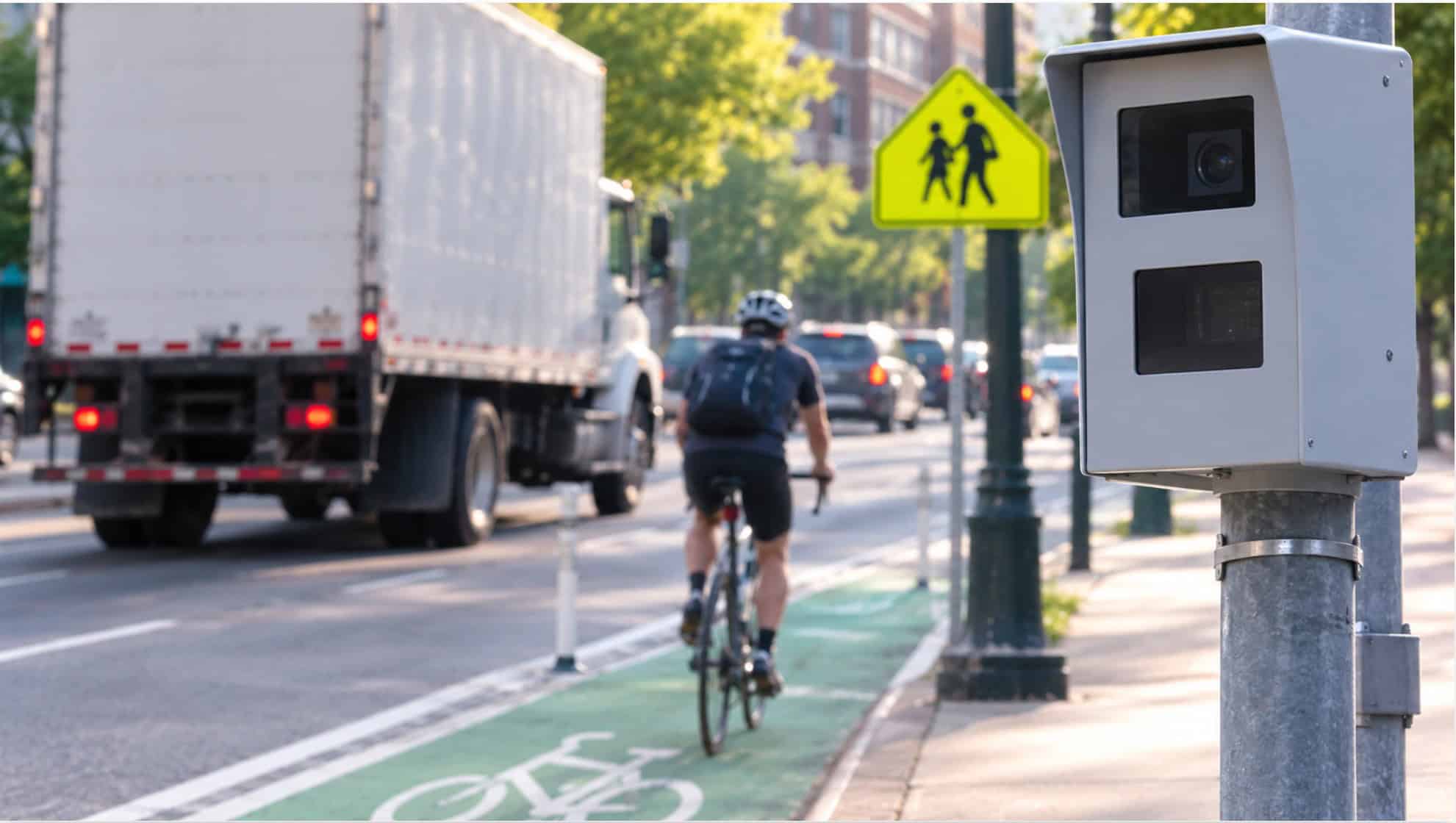
STATE HOUSE, BOSTON, July 27, 2026….Truck drivers whose vehicles lack key safety equipment could face a presumption of liability in fatal crashes involving cyclists, and speed cameras could be deployed in school, safety, and construction zones under a pair of road safety amendments added to an economic development bill during late-night deliberations Thursday.
The amendments, both filed by Sen. Will Brownsberger of Belmont, tee up two closely watched road safety debates.
Truck Safety Amendment Targets Fatal Bicycle Crashes
The truck safety proposal lands just weeks after the death of cyclist Louisa Gag, who was killed in Boston after a collision with a truck, renewing calls from advocates for better bike lanes and regulations on urban drivers sharing the roads.
Brownsberger’s amendment (#160) would create a rebuttable presumption that a truck driver is responsible in a fatal crash involving a “vulnerable road user” such as a cyclist or pedestrian, if that truck is not equipped with certain safety features such as side guards and backup cameras.
However, he told the News Service the just-adopted proposal’s complicated tort law implications make its outlook dim to survive conference negotiations.
Senate Advances Speed Camera Proposal
The Belmont Democrat said he sees stronger prospects for the speed camera amendment (#215), which authorizes automated enforcement in school, safety and construction zones and mirrors legislation Gov. Maura Healey has repeatedly proposed.
Drivers Could Face Automated Speeding Fines
The traffic cam amendment would allow cities and towns to install cameras in school zones, designated safety zones and active construction areas to monitor speeding — and send fines to drivers who violate limits.
Drivers who go over 11 miles per hour over the posted limit in a school zone, when the school is in session, or in an area of construction, would be considered in violation of the proposed traffic law.
Per the language in the amendment, drivers would receive a warning in the mail the first time a camera catches them speeding. For subsequent violations, it would be a $25 fine or $100 if driving over 25+ miles per hour over the limit.
The News Service asked Brownsberger whether the bill would automatically trigger a mailed ticket every time a driver was traveling 12 miles per hour over the speed limit in a school zone during the school day.
“That’s the intention,” he said. “The intent is to consistently catch those who are significantly violating the law.”
Speeding is a primary factor in about one-third of all motor vehicle fatalities, according to advocates including Transportation for Massachusetts and the Families for Safe Streets Massachusetts. As of January 2026, speeding is one of the leading causes of preventable crashes in the state.
Municipalities would be capped at one camera per 5,000 residents, and local governments would choose where they want to put them, targeting repeated problem-areas. There’s no cap to Department of Transportation-installed cameras in work zones.
“There are plenty of neighborhoods that are begging for them. And so that’s where they’re going to go up,” Brownsberger said.
Healey included speed cameras in her fiscal year 2026 and 2027 budget proposals, recommending a program similar to the one proposed in Brownsberger’s amendment, but the House and Senate did not act on the idea in either budget cycle.
Opponents have raised concerns about photos endangering driver and passenger privacy and that municipalities could come to rely on fines as a revenue source.
Brownsberger said he believes using cameras would decrease racial bias in traffic violation enforcement. “Cameras don’t know who’s driving,” he said.
In 2025, Healey scrawled her signatures to measures allowing the MBTA and regional transit authorities to use bus cameras to enforce dedicated bus lanes and bus stops, as well as empowering cities and towns to install monitoring devices on school buses to record nearby vehicles that fail to stop.
Brownsberger frequently bikes to work at the State House from his home in Belmont, though he said lately as he has been on the campaign trail ahead of a competitive November election, he has been relying on his car more.
Truck Safety Amendment Targets Fatal Bicycle Crashes
The senator sees the vulnerable road users amendment as moving the needle, even if it does not become law this session.
“I’m hopeful that that will go across the finish line, but even as I’ve advocated for the truck standards, I was candid with people that, look, I know you might not be able to do this, but let’s at least move it forward, just to move the conversation forward,” he said.
Under a 2022 road safety law, lawmakers and former Gov. Charlie Baker mandated that vehicles owned or contracted by the state must have certain safety features, such as side guards, which help protect cyclists and pedestrians.
Road Safety Debate Continues on Beacon Hill
Brownsberger said that “covers a lot of vehicles” but “there’s a broader scope of vehicles that are tougher for us to regulate, and those are vehicles that don’t contract with the state.”
In a recent supplemental budget, lawmakers created a grant program for municipal vehicles to outfit their trucks with the safety and better visibility equipment. But there are still plenty of commercial trucks coming from other states carrying packages, food deliveries or building equipment into cities with mixed-use roads.
“This is something that is really a problem primarily in Boston, Cambridge, Somerville, and immediately surrounding communities, where you have a lot of cyclists on the road and a lot of trucks in a dense, urban area,” Brownsberger said.
Since the state cannot supersede federal regulations related to vehicle design, Brownsberger said lawmakers have struggled to find a way to require trucks to have the safety equipment on Massachusetts streets.
Liability Proposal Faces Tougher Legislative Path
“This amendment was an effort to address that by saying, okay, look, we don’t think we can mandate design standards for just about every vehicle coming through the state. We don’t think we have the power to do that. But what we should be able to say is, if you harm somebody, and you haven’t taken precautions in the design of your vehicle, then we’ll presume you’re negligent,” he said.
The issue has been in the news lately since city planner Gag was struck and killed by a truck while on her bike in Boston earlier this month. Brownsberger said he was pushing for this bill before Gag’s “tragic death,” but the timing “shines a light on it and makes it all that much more important.”
Her death has re-inflamed debate over bike lanes, and Boston Mayor Michelle Wu promised more protection for cyclists last week, after she came under fire for slowing down infrastructure projects.
Road Safety Debate Continues on Beacon Hill
Brownsberger is running in November against Democrat Daniel Lander, a former Wu staffer who has been endorsed by the mayor.
Asked Monday about the two adopted road safety amendments, Lander was not available for comment but sent a statement saying the speed camera proposal does not go far enough.
“Advocates and the City of Boston have been fighting for the state to take action on common sense street safety laws for years, but Senator Brownsberger and the state senate have been dragging their feet. This amendment on automatic enforcement doesn’t go far enough to give municipalities the enforcement tools they need,” Lander said. “Yet again, the State Senate isn’t listening to local leaders and advocates. We need more urgent leadership on Beacon Hill that will actually fight to make our streets safer for everyone instead of defending the broken status quo.”