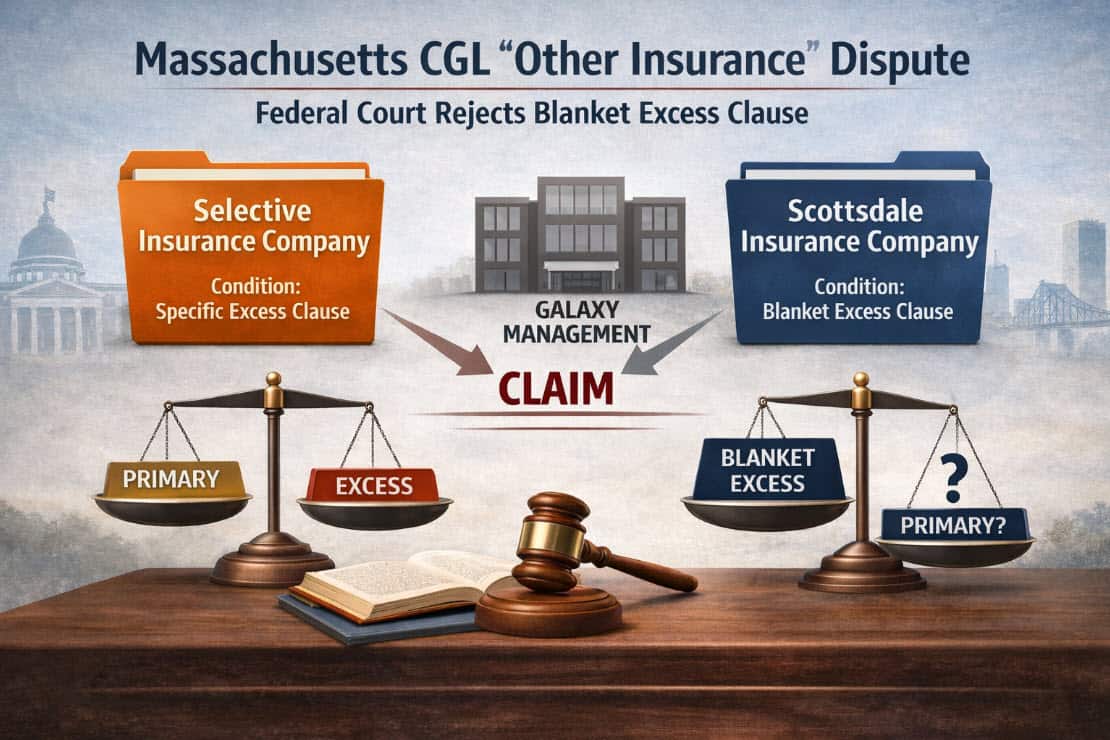
Two carriers insure the same loss. Both CGL policies contain “other insurance” clauses. Both claim to be excess. The dispute over who pays first—a fixture of property and casualty practice in Massachusetts—just got a definitive answer from the federal bench, at least for one increasingly common coverage configuration.
In Selective Insurance Company of the Southeast v. Scottsdale Insurance Company, decided March 20, 2026, Judge Allison D. Burroughs ruled that a blanket catch-all “other insurance” clause cannot, by itself, convert a CGL policy from primary to excess insurance in Massachusetts. Scottsdale Insurance Company learned that lesson at a cost of $116,666.67—the amount the court ordered it to reimburse Selective.
Massachusetts “Other Insurance” Law: The SJC Framework and an Open Question
The analytical starting point is the Massachusetts Supreme Judicial Court’s decision in Great Divide Insurance Co. v. Lexington Insurance Co., 478 Mass. 264 (2017). There, the SJC laid out two paths by which an “other insurance” clause can render a policy excess:
- Path One: The policy contains both a limitation-of-liability clause and an other-insurance clause declaring coverage excess over all other valid and collectible insurance.
- Path Two: The other-insurance clause specifically states that coverage is excess under identified circumstances.
Great Divide involved automobile policies. What the SJC had not addressed was whether a CGL insurer covering property management operations could achieve excess status through a third maneuver: deleting the standard “other insurance” clause and replacing it with a blanket provision declaring itself excess over any other insurance, period, without a separate limitation-of-liability clause and without tying excess status to specific circumstances.
That was the question Judge Burroughs took up. It appears to be one of first impression in this context.
The Underlying Dispute: Galaxy Management and a Shared Settlement
Galaxy Management, LLC was the property manager for a premises at 26 Galaxy Pass in Sutton, Massachusetts, managing on behalf of Galaxy Sutton LLC. A liability claim arose. Both Selective and Scottsdale acknowledged that their CGL policies covered Galaxy Management.
The carriers settled the underlying lawsuit jointly, subject to a reservation of rights. The split was undisputed: Selective paid $116,666.67; Scottsdale paid two-thirds of the total. The parties stipulated that the entire settlement fell below Scottsdale’s $2 million per-occurrence limit.
Then Selective sued Scottsdale, arguing that its policy was strictly excess—and that Scottsdale owed every dollar Selective had put in.
The Policies: Same Form, Different Rewrites
Both carriers started from the same standard CGL form. Unmodified, both would have provided identical primary coverage. But each modified the “other insurance” clause—and how they did it was the whole case.
Selective: A Circumstance-Specific Endorsement
Selective issued a $1 million per-occurrence policy directly to Galaxy Management. Its endorsement provided that where liability:
“aris[es] out of your management of property for which you are acting as real estate manager, this insurance is excess over any other valid and collectible insurance available to you, whether such insurance is primary or excess.”
Selective tied excess status to a specific factual trigger: the insured acting as a property manager. When that trigger was present, the policy was excess. When it was not, the policy was primary. Targeted. Predictable.
Scottsdale: A Blanket Replacement
Scottsdale issued a $2 million per-occurrence policy to Galaxy Sutton LLC and Galaxy Pass LLC, extending coverage to anyone acting as a real estate manager for a named insured. But instead of adding a circumstance-specific endorsement, Scottsdale deleted the standard “other insurance” clause entirely and substituted:
“[This coverage is] excess over any other insurance, whether primary, excess, contingent or on any other basis . . . [t]hat is valid and collectible insurance available to any insured under any other policy.”
No factual trigger. No limitation-of-liability clause. The policy simply declared itself excess whenever any other insurance existed.
CGL “Other Insurance” Ruling: Why Specificity Defeated Scottsdale’s Catch-All Clause
The parties filed cross-motions for judgment on the pleadings. Massachusetts law governed. The sole issue: which policy was primary.
The court applied the established two-step framework. First, determine each policy’s “relationship with [its] insureds” to establish the base coverage type. Second, examine the policies’ “relationship with one another” to see whether one is excess.
Selective’s policy passed easily. The court found it unambiguous. Selective’s endorsement “plainly provided excess coverage to Galaxy Management for the facts at issue here.” The insured was acting as a property manager—precisely the circumstance Selective’s clause identified. Path Two of the SJC’s framework, satisfied.
Scottsdale’s policy did not. The court acknowledged that Scottsdale’s clause purported to make coverage excess. But it found a structural gap: the policy “lacked a separate limitation-of-liability clause making clear that its coverage was excess.” That ruled out Path One.
As for Path Two, the catch-all clause was not circumstance-specific—it was the opposite. Judge Burroughs delivered the key holding:
Enforcing that blanket exception “would render the policy excess in virtually every circumstance.”
The court noted that Scottsdale “failed to identify any Massachusetts case law” permitting a primary CGL policy to convert itself into excess coverage solely through a catch-all provision. Without structural indicia—either a separate limitation-of-liability clause or a circumstance-specific trigger—the clause could not do the work Scottsdale needed.
Result: Scottsdale’s policy was primary. Selective’s was excess. The settlement fell below Scottsdale’s $2 million limit. Selective owed nothing. The court ordered Scottsdale to reimburse the full $116,666.67.
Practical Takeaways from Judge Burrough’s Decision
This is a district court ruling, not binding SJC precedent. But it is the clearest statement to date on how Massachusetts courts will likely evaluate competing “other insurance” clauses in CGL property management disputes.
- For carriers: If you want excess status, draft for it. A circumstance-specific clause tied to identified operations—like Selective’s property management endorsement—satisfies the SJC’s framework. A blanket catch-all that declares excess status over any other insurance, without more, does not.
- For agents and brokers: When placing property management risks with CGL coverage from multiple carriers, look at the “other insurance” modifications. The language in those endorsements will determine who pays first—and whether your client has an allocation dispute waiting to surface.
- For counsel: Judge Burroughs’s opinion provides a step-by-step methodology: identify the base coverage relationship, then evaluate the “other insurance” clause against the SJC’s two-path test from Great Divide. A clause that purports to make a policy excess “in virtually every circumstance” will not survive that analysis.