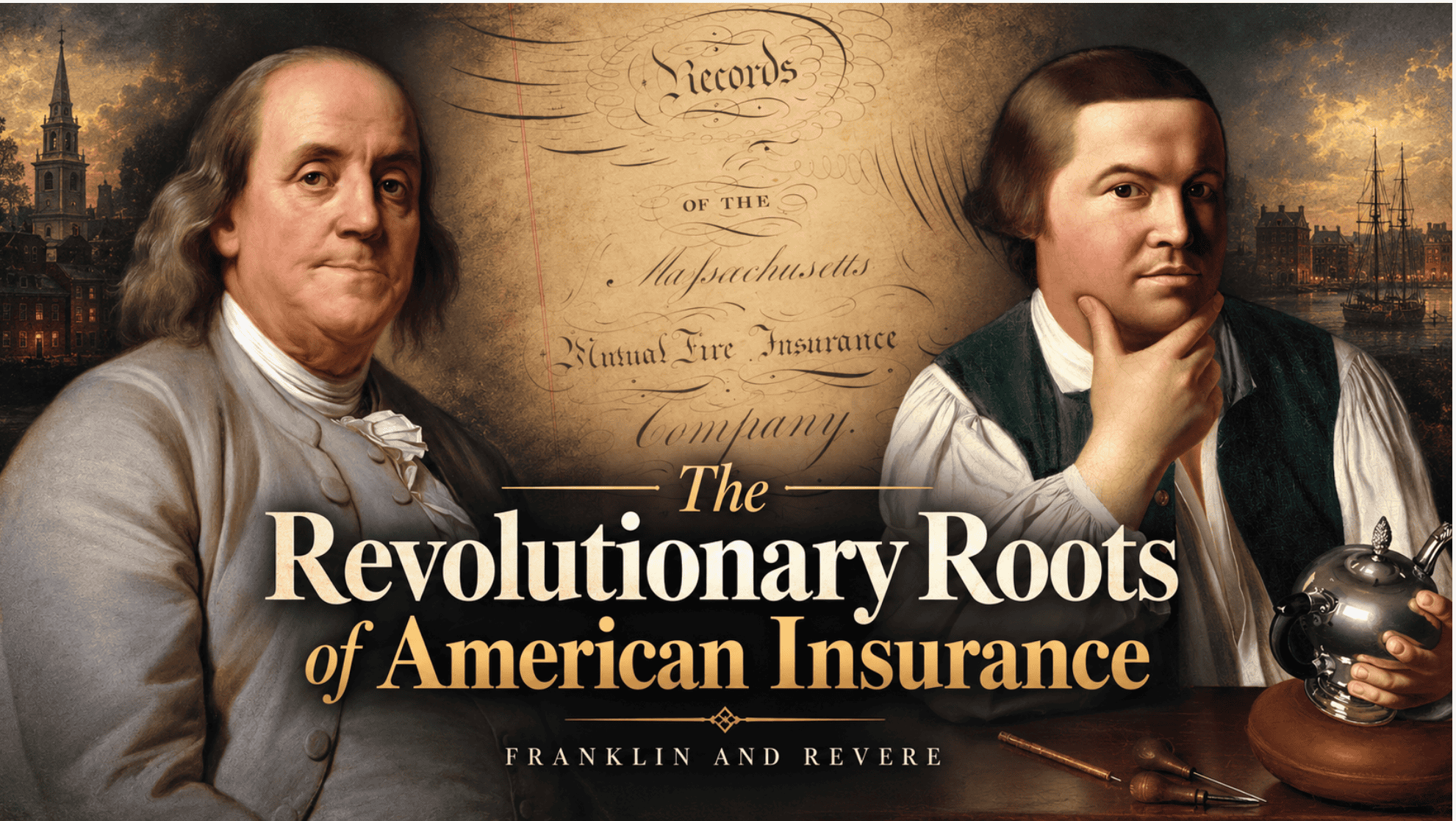
Two of America’s best-known Revolutionary-era figures helped establish early fire insurance companies, including one founded in Boston in 1798
In honor of the MAIA’s 2026 Big Event theme, “From Revolution to Resilience,” celebrating 250 years of American independence and the enduring role of independent insurance agents, Agency Checklists looks back at two Revolutionary-era figures who also helped shape the early American insurance industry.
Benjamin Franklin and Paul Revere are arguably two of the most recognizable figures from America’s founding era. While each played a key role in our country’s fight for independence, both also helped shape the country’s insurance industry by helping establish two of the earliest American fire insurance companies. Franklin, a Boston native, helped organize an insurer in Philadelphia more than two decades before American independence, while Revere was among the founders of a Massachusetts fire insurance company in 1798.
Their involvement illustrates how organized property insurance developed in colonial America and the early years of the republic, introducing underwriting and risk-sharing practices that remain familiar to insurance professionals today.
Benjamin Franklin and the Beginnings of American Property Insurance
Benjamin Franklin was born in Boston on January 17, 1706, nearly 70 years before the Declaration of Independence was signed. Although best remembered for his contributions as an inventor, printer, diplomat, and Founding Father, Franklin also played an important role in establishing the American property insurance industry.
In 1752, Franklin and fellow members of Philadelphia’s volunteer fire companies founded the Philadelphia Contributionship for the Insurance of Houses from Loss by Fire. Modeled after London’s Amicable Contributionship, the group organized the new entity as a mutual insurer in which participating property owners shared the financial risk of fire losses. At the time, Philadelphia had approximately 15,000 inhabitants and eight volunteer fire companies. Although the city employed fire prevention measures, including relatively wide streets and brick and stone construction, property owners remained vulnerable to substantial financial losses from fires.
In order to attract clients to its new venture, the company advertised its proposed insurance arrangements in The Pennsylvania Gazette in February 1752. By April, sufficient interest had developed to organize the company and elect its board of directors.
How the Philadelphia Contributionship Worked
In June of that same year, the Contributionship began issuing seven-year renewable policies covering buildings. Policyholders paid a deposit that was refundable at the end of the term, less specified charges for property surveys, policies, and fire marks.
Interestingly, the company’s underwriting procedures would be somewhat recognizable to modern property insurance professionals. Before insuring a property, surveyors were sent to inspect a building. After the inspection, the surveyor submitted a report describing the property’s characteristics and condition. The directors then reviewed these reports and set the insurance amount and rate.
Insured buildings displayed metal fire marks bearing the company’s emblem of four clasped hands, symbolizing the mutual contributions of its policyholders.
Franklin’s involvement also extended to printing the company’s early insurance policies, according to its historical archives.
The company established a capital fund in 1763, received incorporation approvals in 1768 and 1769, and began offering perpetual fire insurance policies in 1810.
Today, more than 270 years after its founding, the Philadelphia Contributionship continues to operate as a property insurer. Its affiliated insurance company markets homeowners’ policies through insurance agents and brokers.
Paul Revere and the Massachusetts Mutual Fire Insurance Company
Back in Boston, another former patriot saw the potential of insurance and, nearly half a century after Franklin established the Philadelphia Contributionship, joined forces with other prominent Bostonians to organize a fire insurance company.
In 1798, Paul Revere, the Boston silversmith and Revolutionary War patriot best known for his midnight ride in April 1775, became one of the founding members of the Massachusetts Mutual Fire Insurance Company.
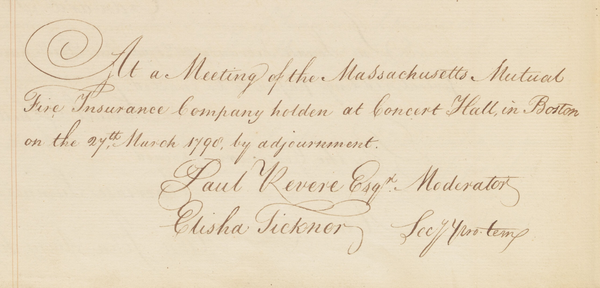
Early Massachusetts Insurance Records Preserve the Company’s History
The company’s incorporation documents and other historical records are preserved in two volumes at Harvard Business School’s Baker Library Special Collections, covering the period from 1798 through 1872. The collection offers a unique view into the company’s beginnings and the many prominent people and institutions it did business with.
According to Harvard’s archival description, Revere was among the company’s original corporate members, along with jurist George R. Minot, merchant Elisha Ticknor, physicians David Townsend and Isaac Rand, and political figures William Eustis, John Coffin Jones, and Thomas Dawes.
The records also identify several other prominent figures among the company’s subscribers, including Samuel Adams and John Quincy Adams. Other subscribers included Boston merchants Stephen Higginson and John Codman, physicians Samuel Danforth and Aaron Dexter, and several Harvard College officials.
The company’s policyholders extended beyond prominent individuals. The surviving records identify the Boston Lying-In Hospital and Phillips Academy in Andover among the institutions insured.
The two volumes contain the original 1798 incorporation documents, minutes of corporate meetings, signatures of subscribers, premium tariffs, insurance policies, correspondence and an advertisement published in 1800.
The surviving records provide a view of the operation of an early Massachusetts insurer, including the individuals and institutions that participated in its development.
An Insurance Legacy That Predates American Independence
While Benjamin Franklin and Paul Revere are remembered primarily for their roles in American history, their involvement in the early insurance industry reflects a recognition that protecting property against financial loss was important even in colonial America and the early republic.
As the Massachusetts Association of Insurance Agents celebrates 250 years of American independence, these men’s contributions provide a fitting historical connection between the nation’s founding and the insurance industry that serves Massachusetts businesses and families today.