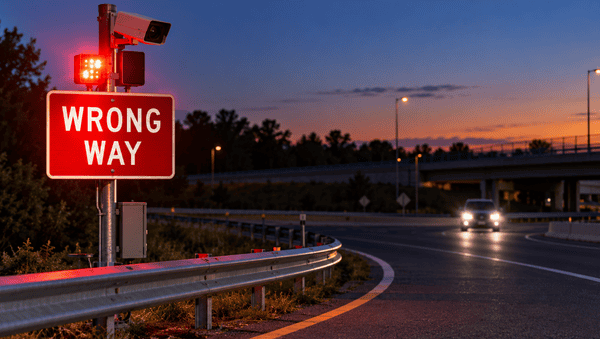
Revere crash looms over one-way driving offensive
STATE HOUSE, BOSTON, Oct. 26, 2026…..Since June, the state’s detection systems have recorded more than 215 wrong-way driving events with about 140 drivers self-correcting, an agency official announced on Monday, while saying more work needs to be done.
That self-correction rate “far outperforms” detection systems the Massachusetts Department of Transportation deployed during a 2022 pilot program, MassDOT Undersecretary Jonathan Gulliver said during a press conference.
MassDOT Plans 300 Detection Systems Statewide
Gulliver said that since June, the agency has installed almost 90 detection systems with another 40 that are “in some state of construction” and expected to be operating by the end of the year. By this time next year, Gulliver said, around 300 detection systems will be on roads across the state.
“To my knowledge, that is the fastest rollout of this kind of system in the entire United States,” said Gulliver, MassDOT’s highway administrator who is leaving his post to be executive director of the Massachusetts Water Resources Authority.
Also, he said MassDOT has bought 12 portable detection systems that could be deployed within a day.
Gulliver: Tragedy a reminder that there’s ‘a lot more work to be done’
“There is still a lot more work to be done, that’s evidenced by the terrible crash that happened in Revere over this weekend. Something we want to acknowledge that this is why we do this. We want to make sure we have as many protections as we can in place for all drivers of Massachusetts,” Gulliver said.
MassDOT’s press conference on detection systems, improved roadway signage, and safety upgrades at more than 800 locations was livestreamed by Boston 25 News. It comes after a senior at Triton Regional High School was reportedly killed in a wrong-way driving crash early Sunday morning on Route 1 in Revere. A State Police spokesperson said the crash is still under investigation and they are not releasing the identity of the driver, who is a minor and junior operator.
Wrong-Way Driving Prevention Now Required Under State Plan
This year’s state budget included a measure sponsored by Senate Minority Leader Bruce Tarr requiring MassDOT to implement a comprehensive plan to prevent wrong-way driving including signage, lighting and detection systems. MassDOT must also update the plan every three years.
Tarr said the crash Sunday serves as a reminder of the “urgency and importance of our mission.”
Tarr said that he was inspired to address wrong-way driving after Chris Dailey, an 18-year-old Gloucester resident died on July 4, 2025 as a result of a car crash involving a wrong-way driver. Tarr’s budget amendment also came weeks after State Trooper Kevin Trainor was killed while responding to a wrong-way driver call on Route 1 in Lynnfield.
“Once again, on the North Shore, we are having to come to grips with the tragic loss of a 17-year-old driver. A high school student just beginning on his path in life. Taken from us by wrong-way driving,” Tarr said on Monday. “It reminds us that this threat exists on roadways across our state. It reminds us that it can strike when we perhaps least expect it and it reminds us that all of us are potential victims.”
Sunday’s crash was one of three wrong-way driving reports police officers responded to over the weekend, said Massachusetts State Police Lieutenant Colonel Brendan Shugrue.
“These incidents underscore a sobering reality – wrong-way driving is not a remote or hypothetical danger. It is happening on our roadways and its consequences can be irreversible,” Shugrue said.
AAA Says Fatal Wrong-Way Crashes Have Nearly Doubled Nationally
In June, AAA Northeast reported that fatal wrong-way crashes across the country have almost doubled on divided highways between 2014 and 2023. In Massachusetts, 135 people have died in more than 5,700 wrong-way crashes from 2018 to 2025, according to AAA Northeast’s analysis of data from the state’s IMPACT crash portal.
Both Tarr and Shugrue said eliminating the threat of wrong-way driving requires more than just technology.
Shugrue said drivers need to be alert, witnesses need to make timely 911 calls and there needs to be meaningful enforcement and public education. Tarr said more than 600 interchanges across the state need to be assessed to make sure that they are “as safe as they could possibly be.”
Next-Generation Alerts Could Reach Drivers Directly
As far as the detection systems, Gulliver said that when one senses a wrong-way driver, lit signs will flash at the driver to signal they are going the wrong-way and an alert is sent to MassDOT and State Police. The next iteration of the system includes an alert about wrong-way drivers sent directly to drivers, including those using mapping apps like Waze or Apple Maps, Gulliver said, estimating that technology would be available this time next year.
The detection systems are also collecting data for MassDOT to use when considering physical interchange exit changes.
“If we can make an interchange safer by making some physical changes to it, that’s the ideal situation,” Gulliver said.
MassDOT and Gov. Maura Healey have estimated a $75 million total cost to pursue anti-wrong way driving initiatives.