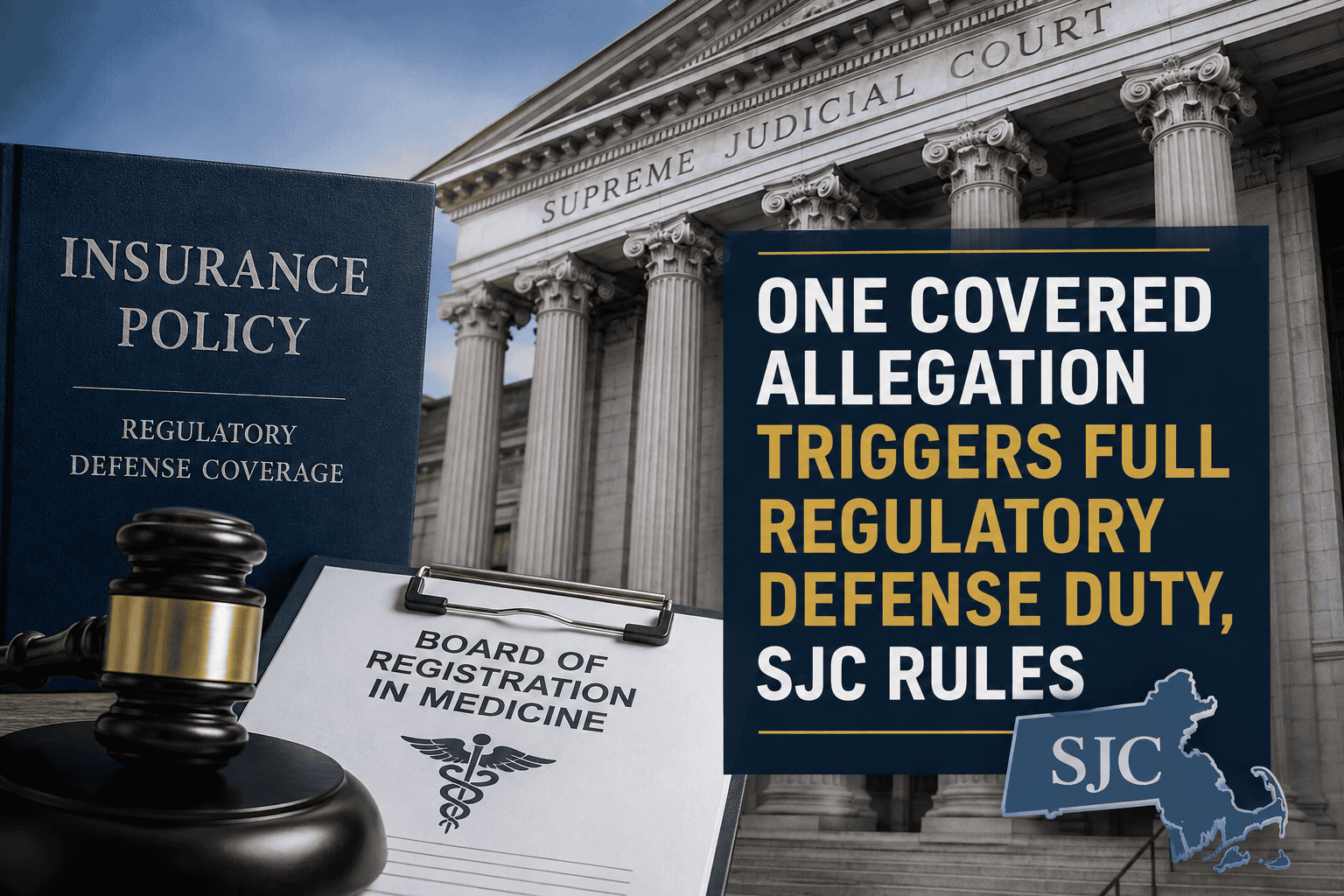
SJC Applies Broad Duty-to-Defend Standard to Regulatory Defense Coverage
The Massachusetts Supreme Judicial Court has ruled that an insurer’s obligation to pay defense costs for a professional licensing proceeding is governed by the same broad coverage principles that apply to the traditional duty to defend.
In William E. O’Connor v. MAG Mutual Insurance Company, SJC-13821, the Court held that MAG Mutual’s limited regulatory defense coverage was triggered because a Board of Registration in Medicine proceeding against an insured physician included an allegation involving the prescribing of medication — an act the Court concluded constituted providing a professional service.
That was enough to trigger coverage, even though most of the allegations underlying the Board proceeding alleged criminal conduct that the SJC agreed fell outside the scope of professional services.
A unanimous SJC vacated the Bristol Superior Court judgment for MAG Mutual and remanded the case back to the Superior Court for further proceedings consistent with the SJC’s opinion.
A $50,000 Regulatory Defense Provision
Dr. William E. O’Connor purchased a medical professional liability policy from MAG Mutual with a one-year term beginning Sept. 1, 2019.
Among its provisions, the policy provided “limited regulatory defense” coverage for proceedings involving O’Connor’s medical license.
The policy defined regulatory defense to include defense costs for an investigation, hearing, formal action or administrative proceeding brought by a licensing board or regulatory authority arising out of either a covered claim or “a patient complaint about [the insured’s] professional activities.”
“Professional activity,” in turn, was defined as providing medical professional services to a patient. The policy did not define “professional services.”
The regulatory defense coverage carried a $50,000 limit.
The Board Proceeding
The coverage dispute arose from a complaint filed with the Massachusetts Board of Registration in Medicine in December 2019 by the husband of O’Connor’s former patient.
The husband alleged that O’Connor had stalked the patient, left harassing voicemail messages, stolen her mail and surveilled her property. He also alleged that O’Connor violated an abuse prevention order by trespassing on the patient’s property and attempting to break into her home.
But the complaint contained another allegation that ultimately proved decisive for insurance coverage.
According to the complaint, O’Connor had prescribed an addictive medication to the patient for approximately six years during their relationship. The husband alleged that the patient’s primary care physician had stopped prescribing the medication because of concerns about its addictive nature and that O’Connor used the drug’s addictive qualities as “leverage” to make the patient dependent on him and remain in the relationship.
The Board’s investigation confirmed that O’Connor had prescribed the medication approximately two dozen times between November 2012 and October 2016.
In February 2020, Board complaint counsel sought the summary suspension of O’Connor’s medical license pending a hearing on whether his license should be revoked.
O’Connor notified MAG Mutual and sought regulatory defense coverage.
MAG Mutual denied coverage.
Among other grounds raised during the coverage dispute, the insurer maintained that the allegations concerning stalking, trespass, and theft did not involve professional services. MAG Mutual also questioned whether the prescription-related allegations constituted covered professional activity.
O’Connor challenged the denial and sought payment of the regulatory defense limit, asserting that his defense costs already exceeded the policy limit.
Superior Court Finds No Coverage
O’Connor subsequently brought an action in Bristol Superior Court seeking a declaration that MAG Mutual was obligated to provide regulatory defense coverage. He also asserted breach of contract and G.L. c. 93A claims.
Following a jury-waived trial based on agreed facts and exhibits, Superior Court Judge Elaine M. Buckley ruled for MAG Mutual.
The Superior Court concluded that the Board proceeding arose from alleged criminal conduct rather than professional services.
The judge also rejected O’Connor’s argument that the prescribing allegation was sufficient to trigger coverage, concluding that prescribing medication for the alleged purpose of coercing the patient to continue the relationship could not be construed as providing professional services.
Judgment entered for MAG Mutual on all counts.
O’Connor appealed, and the SJC transferred the case from the Appeals Court on its own initiative.
SJC Applies Duty-to-Defend Principles
Writing for the Court, Justice Dalila Argaez Wendlandt began with the legal standard governing MAG Mutual’s obligation to pay regulatory defense costs.
That portion of the decision is particularly significant for insurers providing defense-cost coverage outside the conventional civil lawsuit setting.
The policy provision did not require MAG Mutual to assume control of O’Connor’s defense in the manner of a conventional liability policy. It required the insurer to provide defense costs for a qualifying regulatory proceeding.
Nevertheless, the SJC concluded that Massachusetts cases addressing the duty to defend informed the analysis because both situations involve an insurer’s obligation to cover defense costs before the underlying matter has been resolved.
The Court explained that the coverage inquiry therefore had to be conducted before resolution of the regulatory proceeding and on the basis of the allegations made against the insured.
Under Massachusetts duty-to-defend law, uncertainty over whether allegations potentially fall within coverage is resolved in favor of the insured.
The allegations do not have to establish coverage “specifically and unequivocally.” They need only demonstrate a possibility that the claim falls within the policy.
The SJC therefore asked whether the allegations underlying the Board proceeding were reasonably susceptible to an interpretation that stated or roughly sketched a claim covered by MAG Mutual’s regulatory defense provision.
Most of the Allegations Were Not Professional Services
The SJC agreed with MAG Mutual on an important part of the case.
The allegations concerning O’Connor’s alleged stalking, harassing telephone messages, theft of mail, surveillance, trespassing, and attempted break-in were not professional services.
None required membership in the medical profession or involved rendering patient care.
As the Court explained, the fact that the person allegedly committing an act happens to be a physician does not transform the conduct into a professional service.
But the prescribing allegation required a different analysis.
Prescribing Medication Changed the Coverage Analysis
The SJC concluded that prescribing medication to a patient is an act requiring the specialized learning associated with the medical profession.
Only certain licensed health care professionals can prescribe medication, the Court noted, and prescribing controlled substances is governed by state and federal law.
The Board materials also could be read as alleging that O’Connor was rendering care to the patient when he prescribed the medication.
Most importantly for the coverage analysis, the allegations permitted an inference that the patient potentially suffered harm from the continued prescriptions themselves.
The complaint alleged that O’Connor continued prescribing the addictive medication after the patient’s primary care physician would no longer prescribe it because of its addictive qualities.
The Court concluded that, on the face of the complaint, this created a potential causal relationship between harm to the patient and a professional medical act.
That distinguished the case from Roe v. Federal Insurance Co., the 1992 SJC decision relied upon by the Superior Court.
Roe involved the duty to indemnify a dentist following allegations of sexual assault. The professional dental service involved in that case did not itself cause the patient’s alleged injury. In Roe, it was the sexual assault the patient alleged that caused the claimed injuries, and not any dental services.
O’Connor, by contrast, involved the obligation to provide defense costs, where allegations need demonstrate only a possibility of coverage.
The SJC concluded that the allegations concerning O’Connor’s prescribing of the medication constituted the provision of a professional service.
One Covered Allegation Triggered the Regulatory Defense
Once the prescribing allegation potentially came within the regulatory defense coverage, MAG Mutual’s obligation was triggered for the Board proceeding.
The SJC applied Massachusetts’ established “in for one, in for all” rule: when one allegation triggers the duty to defend, the insurer must defend the entire action, including claims or allegations that are not covered.
That rule was consequential here because the Court had already concluded that the allegations of stalking, harassment, theft, surveillance, and trespassing were not professional services.
The covered prescribing allegation nevertheless triggered MAG Mutual’s obligation to provide regulatory defense coverage.
The Court therefore vacated the Superior Court judgment for MAG Mutual and remanded the case for further proceedings consistent with its opinion.
The Coverage Litigation Now Returns to Superior Court
The SJC did not itself determine the amount of O’Connor’s recoverable defense costs or resolve the remaining monetary issues. Those matters return to the Superior Court following remand.
There is also a separate question concerning the attorney’s fees O’Connor incurred establishing MAG Mutual’s coverage obligation.
The SJC did not discuss that issue. Its decision, however, establishes the predicate coverage obligation: MAG Mutual had a duty to provide regulatory defense coverage.
Under the rule established in Preferred Mutual Insurance Co. v. Gamache, an insured who successfully establishes an insurer’s duty to defend may recover the reasonable attorney’s fees incurred in establishing that duty. The application and amount of any such recovery in O’Connor’s case were not decided by the SJC and remain matters for further proceedings.
O’Connor also asserted a claim under G.L. c. 93A. The SJC did not address the merits of that claim. The Superior Court judgment was vacated, and the matter remanded for further proceedings.
The Broader Insurance Coverage Point
Although O’Connor arose from a medical professional liability policy and a physician licensing proceeding, the Court’s coverage analysis turned on familiar Massachusetts duty-to-defend principles.
The significance is the SJC’s treatment of a policy obligation to provide defense costs for an administrative proceeding.
The Court held that the determination is made before the underlying regulatory matter is resolved and from the allegations giving rise to the proceeding. Those allegations only need to show a possibility of coverage.
And where one allegation potentially falls within the regulatory defense provision, uncovered allegations do not eliminate the insurer’s defense obligation.
In O’Connor, a Board proceeding dominated by allegations the SJC itself determined were outside the insured’s professional services nevertheless triggered regulatory defense coverage because one allegation — the prescribing of medication — potentially arose from a professional service.
For those individuals interested in reading more insurance coverage articles by Owen Gallagher, peruse our archives here.

Owen Gallagher
Insurance Coverage Legal Expert/Co-Founder & Publisher of Agency Checklists
Interested in connecting with me? Call me directly at 617-598-3801.