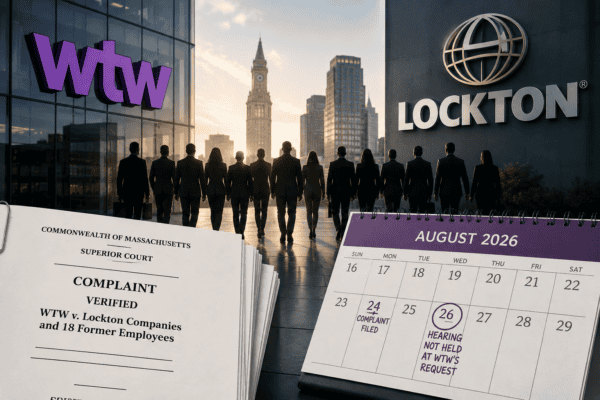
Willis Towers Watson has sued Lockton Companies and 18 former WTW employees after members of its New England construction insurance brokerage team resigned within a 44-minute period and immediately joined Lockton.
WTW alleges the coordinated Aug. 19 departures were followed within hours by efforts to move construction clients to Lockton. The brokerage says clients lost within 48 hours generated more than $5 million in annual revenue.
WTW filed its 67-page verified complaint Aug. 24 in Suffolk Superior Court against Lockton and the 18 former employees, seeking temporary, preliminary and permanent injunctive relief as well as damages. The allegations have not been adjudicated.
18 WTW Employees Resign Within 44 Minutes
According to the complaint, Michael Scott, WTW’s New England construction team leader, resigned by email at 8:02 a.m. Aug. 19, effective immediately.
Seventeen other employees followed by 8:46 a.m.
The resignations included senior managing directors, client relationship managers, broking managers, placement specialists and service-and-delivery employees. WTW alleges none provided the 15 days’ written notice required by their employment agreements.
Most were assigned to WTW’s Boston office. Four were assigned to offices in Pennsylvania or Alabama but, according to WTW, worked with the Boston-based construction team and had business dealings with Massachusetts and New England clients.
WTW alleges all 18 immediately began working for Lockton.
WTW Says Client Broker of Record Letters Followed Within Hours
The client movement alleged in the complaint occurred almost as quickly as the employee departures.
WTW says that since Aug. 19 it has received broker-of-record letters from clients or insurers involving 14 accounts previously serviced by the departing employees. Five of the BORs expressly identified Lockton as the new broker. WTW alleges the remaining accounts also were moving to Lockton.
The complaint says clients lost within 48 hours generated more than $5 million in annual revenue. WTW also alleges additional client relationships remained at risk.
Lockton Offer Allegedly Included 10-Year Salary Guarantee
WTW’s complaint traces the dispute back to compensation negotiations involving Scott in 2025.
According to WTW, Scott told a senior WTW construction executive in November 2025 that Lockton had offered him and his team a compensation package.
WTW alleges Scott described an offer that included a salary equal to a 25% increase over the combined amount of his existing WTW salary and bonus, guaranteed for 10 years. The alleged package also included a $500,000 annual bonus guaranteed for five years, a 30% production bonus on Scott’s book of business, a $250,000 bonus for each $2 million in booked business generated by his team and “no-cut” contracts for team members.
WTW says it subsequently renegotiated compensation for members of the construction team, including substantial increases in base and bonus compensation and partial production credit for certain WTW “house” clients.
The complaint further alleges that during a March 2026 leadership meeting, Scott threatened to leave WTW and take his team and WTW clients if he did not receive a senior position in a planned reorganization.
WTW Alleges Pre-Departure Misconduct
WTW alleges Scott disparaged a candidate being considered for its New England construction team on Aug. 17, calling the candidate a “bottom feeder.” WTW says it later learned Scott offered the candidate a Lockton position on Aug. 20.
The complaint separately points to an unfinished request for proposal involving an existing WTW client. Scott, Mark Toglia and Brian Quinn had been assigned portions of the presentation, which Scott allegedly said would be ready by the morning of Aug. 19. WTW alleges the promised work was not completed before the three employees resigned.
Restrictive Covenants Are Central to WTW’s Claims
WTW’s case does not rest on an allegation that the employees were prohibited from working for a competitor.
Instead, WTW alleges their employment agreements contained confidentiality, client and employee non-solicitation provisions and a 15-day advance-notice requirement. WTW says its restrictive covenants permit employees to join competitors but restrict specified conduct involving confidential information, clients and employees.
The complaint contains 18 breach-of-contract counts, one against each former employee. Count VII also alleges William Darrin failed to repay a $98,000 signing bonus following his resignation.
WTW additionally asserts claims against Scott and Thomas Grandmaison for breach of the common-law fiduciary duty of loyalty and against Lockton for aiding and abetting those alleged breaches and tortious interference with contractual relations.
WTW Cites Lockton’s Earlier Delaware Litigation
In seeking emergency injunctive relief, WTW points to Mountain West Series of Lockton Companies, LLC v. Alliant Insurance Services, Inc., a Delaware case in which Lockton itself sought relief after employees departed for a competitor.
WTW argues that Lockton should now be subjected to comparable relief, including an order preventing further interference with the former employees’ contractual obligations and requiring Lockton to relinquish client relationships WTW alleges were improperly obtained.
WTW also seeks compensatory and other damages, attorneys’ fees and costs.
Emergency Injunction Hearing Put on Hold
WTW moved quickly after filing its complaint. The Suffolk Superior Court docket scheduled a preliminary-injunction hearing before Judge Debra A. Squires-Lee for 10 a.m. Aug. 26, two days after the complaint was filed.
The hearing was not held at WTW’s request. The docket states: “Parties may have reached resolution. Request stay on any action on Motion for TRO/PI.”
The docket entry does not disclose the terms of any potential resolution or indicate whether it would resolve the lawsuit itself or only WTW’s request for immediate injunctive relief.
Earlier Brown & Brown Case Offers Massachusetts Parallel
The procedural pause comes less than a year after another major insurance brokerage employee dispute came before the same Suffolk Superior Court judge.
In Brown & Brown Inc. v. Howden US Services LLC, Judge Squires-Lee entered a consented-to temporary restraining order in December 2025 while an evidentiary hearing on a preliminary injunction remained pending.
The order restricted former Brown & Brown employees and Howden from soliciting certain Brown & Brown employees and client accounts and prohibited use of Brown & Brown confidential information. Handwritten modifications to the order, however, permitted the defendants to continue servicing clients that had signed broker-of-record letters by a specified deadline.
The order also required the return of confidential information and preservation of documents and electronically stored information.
The Brown & Brown order does not establish what WTW and Lockton may have agreed to in the present case. It does provide a recent example from the same court and judge of an interim arrangement addressing employee solicitation, client relationships, BORs and confidential information while an insurance brokerage employment dispute remained pending.