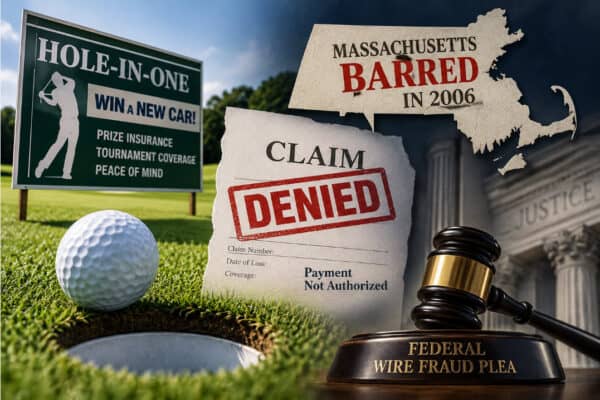
Massachusetts insurance regulators barred Kevin Kolenda from selling insurance in the Commonwealth in 2006 after finding that his prize-guarantee contracts were insurance and that neither he nor his company was licensed to sell them. Nearly two decades later, Kolenda has pleaded guilty to federal wire fraud arising from another prize insurance business.
Kolenda, 69, of Norwalk, Connecticut, pleaded guilty on September 15 in U.S. District Court in Bridgeport to one count of wire fraud under 18 U.S.C. § 1343. The charge carries a maximum prison term of 20 years. His sentencing is scheduled for December 15.
The guilty plea follows years of insurance regulatory and criminal actions against Kolenda in multiple states, including a Massachusetts Division of Insurance proceeding involving 31 unauthorized insurance contracts.
Kolenda Admits Wire Fraud In Prize Coverage Business
According to his plea agreement, Kolenda operated Hole-in-Won LLC, Compliance HIW LLC, Hole-in-Won Worldwide and Hole-in-Won.com from Norwalk. The entities purported to provide prize coverage for promotions and events including golf tournaments and fishing contests.
Kolenda admitted that, beginning in or before 2019 through at least April 2024, he intentionally defrauded customers by making material misrepresentations, including half-truths, to induce customers to pay premiums while avoiding payment of certain claims for insured prizes.
As one example, Kolenda admitted that Hole-in-Won entered into two contracts with the Mount Carmel VFW in Pennsylvania in 2021. The contracts called for Hole-in-Won to pay $1 million if a golfer made a hole-in-one on a designated hole and $10,000 for a successful 60-foot-plus putt, in exchange for $500 in contract fees.
Kolenda admitted that he did not intend to make those payments when he entered into the contracts.
Massachusetts Barred Kolenda From Insurance In 2006
Massachusetts insurance regulators had taken action against Kolenda two decades before his federal guilty plea.
In February 2006, the Massachusetts Division of Insurance found that Kolenda and Golf Marketing Worldwide, L.L.C. had sold 31 unauthorized insurance contracts.
The Division found that Golf Marketing Worldwide offered products to sponsors of golf tournaments and other events under which it guaranteed payment of a prize if a specified event, such as a hole-in-one, occurred. The Division concluded that by serving as guarantor for those prizes, the company issued insurance contracts within the meaning of G.L. c. 175, §3. Neither Golf Marketing Worldwide nor Kolenda was licensed by the Division to sell insurance.
The Division imposed a $31,000 fine and prohibited Golf Marketing Worldwide and Kolenda from directly or indirectly transacting or acquiring any insurance business in Massachusetts.
Federal Case Describes How The Scheme Worked
The superseding federal indictment alleged that Hole-in-Won advertised prize insurance to organizations sponsoring events and collected premiums in exchange for agreeing to pay the cost of prizes when participants won.
The indictment alleged that Kolenda made material misrepresentations to obtain premiums and avoid paying claims. Among other things, prosecutors alleged that customers seeking payment were referred to a Hole-in-Won “claims department” at a Washington, D.C., office that did not exist.
The U.S. Attorney’s Office said Kolenda also made excuses for payment delays, threatened customers with bogus legal action and reputational harm, and ultimately stopped responding to some customers seeking payment.
The superseding indictment identified transactions involving substantial premiums, including $40,000 from the Montana Chamber Foundation, $29,341 from Reynolds Subaru, $25,000 each involving the Stanley Volunteer Fire Department and Early Recognition Is Critical, and $20,000 involving Maschari Marketing.
Those transactions were allegations in the superseding indictment; Kolenda pleaded guilty specifically to Count Four.
State Regulators Had Pursued Kolenda For Years
The federal record also documents a lengthy regulatory history.
Connecticut Insurance Department Principal Attorney Anthony Caporale told federal investigators that the department became aware around 1995 that Kolenda was selling insurance without a license. Caporale said Kolenda and Hole-in-Won were never authorized to sell insurance in Connecticut.
The U.S. Attorney’s Office said cease-and-desist orders, judgments or other legal actions involving Kolenda’s prize insurance sales had been issued in Connecticut, Iowa, North Carolina, Washington, Massachusetts, Oregon, Nevada, Virginia, Minnesota, Pennsylvania, California and Arkansas.
Federal Court Revoked Kolenda’s Release
Kolenda’s activities continued after his April 2024 federal arrest.
A federal magistrate judge later found by clear and convincing evidence that Kolenda violated a release condition barring him from selling prize insurance without the required license and ordered him detained pending trial.
The court found that between September and December 2025, Kolenda sold prize insurance associated with approximately 16 to 20 golf events. Several witnesses said they communicated with someone calling himself “Bob,” and Kolenda’s assistant testified that “Bob” was Kolenda. Credit-card records corroborated $20,644.97 in premiums from the witnesses.
One event produced a hole-in-one winner entitled to a new car. According to the court, after receiving no response from Kolenda for an extended period, the sponsoring dealer supplied a new vehicle from its own inventory.
Plea Agreement Calls For Restitution
The plea agreement calculates an advisory Guidelines offense level of 19 and initially places Kolenda in Criminal History Category IV, which would produce an advisory imprisonment range of 46 to 57 months. The parties reserved the right to recalculate his criminal history category.
The agreement also provides for restitution, with the amount to be determined by the court. Kolenda’s sentencing is scheduled for December 15.