BOSTON — Liberty Mutual Holding Company Inc. reported second-quarter net income attributable to the company of $2.634 billion, up 42.8% from $1.845 billion a year earlier as lower catastrophe losses and stronger investment results helped lift earnings.
The Boston-based insurer’s consolidated combined ratio improved 0.8 point to 86.4%, while second-quarter catastrophe losses fell 43.7% to $455 million from $808 million. Consolidated net written premiums declined 1.1% to $11.088 billion.
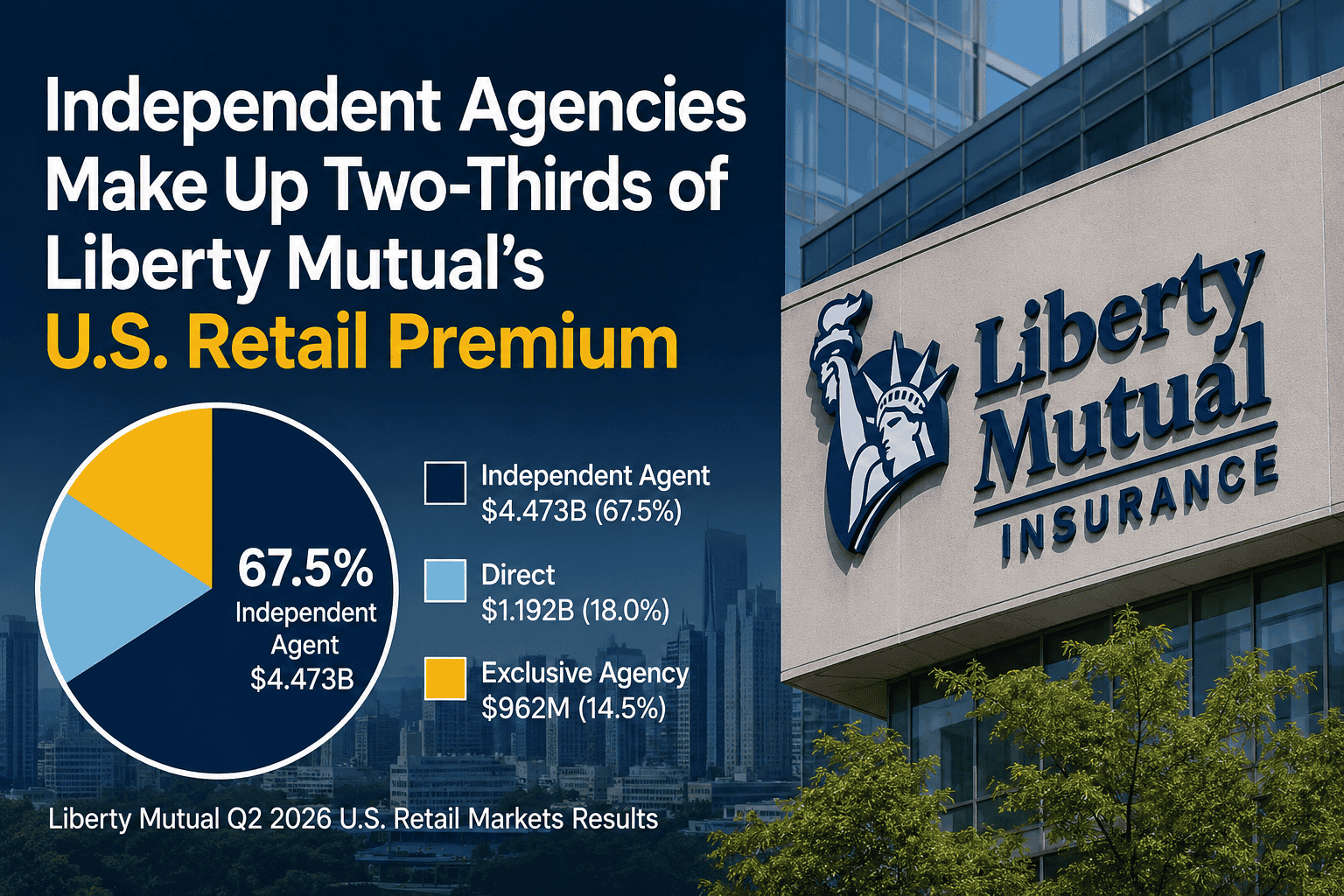
But for independent insurance agents, the more notable development in Liberty Mutual’s second-quarter results is the scale of the company’s transformation of its U.S. distribution system. Independent agents accounted for $4.473 billion, or approximately 67.5%, of the $6.627 billion in second-quarter net written premiums reported by Liberty Mutual’s U.S. Retail Markets business.
Direct business accounted for $1.192 billion, or about 18%, while $962 million, or approximately 14.5%, came from the former Liberty Exclusive Agency channel. Liberty Mutual says that former exclusive-agency premiums are in runoff and are now managed through Comparion.
During Liberty Mutual’s earnings call, U.S. Retail Markets President Hamid Mirza identified direct business, including partnerships, and independent agency as the company’s go-forward distribution channels.
Independent Agency Is Liberty Mutual’s Largest USRM Channel
Liberty Mutual’s quarterly results show independent agency distribution is now by far the largest of its three reported USRM channels. Independent-agent NWP of $4.473 billion was nearly 3.8 times the $1.192 billion reported through the direct channel.
| USRM Channel | Q2 2026 NWP | Q2 2025 NWP | Change | Q2 2026 Share* |
| Independent Agent | $4.473B | $4.644B | -3.7% | 67.5% |
| Direct | $1.192B | $1.111B | +7.3% | 18.0% |
| Exclusive Agency | $962M | $1.153B | -16.6% | 14.5% |
| Total USRM | $6.627B | $6.909B | -4.1% | 100% |
*Share calculated from Liberty Mutual’s reported second-quarter USRM net written premium.
The channel results moved in different directions during the quarter. Independent-agent premium declined 3.7% from $4.644 billion a year earlier, while direct premium increased 7.3% from $1.111 billion. Exclusive-agency premium declined 16.6% from $1.153 billion as the former Liberty Exclusive Agency book continued in runoff.
Liberty Mutual Narrows Its Go-Forward Distribution Model
Mirza said Liberty Mutual has defined its go-forward channels as direct, which includes partnerships, and independent agency. He also described the transformation of the company’s exclusive agency channel into an independent agency.
The result is a distribution structure centered on two models: direct distribution and independent agency. The quarterly figures show that independent agency currently represents the substantially larger share of USRM net written premium.
Comparion, Liberty Mutual’s independent agency, also remains part of that strategy. Mirza said during the call that Comparion continues to deliver market-level margins with gains above prior-year profit.
US Retail Premium Falls As Profitability Improves
Overall USRM second-quarter NWP declined 4.1% to $6.627 billion from $6.909 billion. Liberty Mutual attributed the decline primarily to lower average written premium per policy in personal lines resulting from rate reductions and a greater mix of six-month auto policies, along with lower small-commercial middle-market renewal premium. Additional new business and improved personal-lines retention partially offset those declines.
Despite the decline in premium, USRM’s pre-tax operating income increased 8.6% to $1.451 billion from $1.336 billion. The segment’s total combined ratio improved 2.9 points to 82.3% from 85.2%, helped by a sharp reduction in catastrophe losses. USRM catastrophe losses fell 50.5% to $371 million from $750 million.
The underlying results were more mixed. USRM’s underlying combined ratio increased 3.1 points to 80.1%, while its underwriting expense ratio rose 5.2 points to 30.9%. Liberty Mutual attributed the higher underwriting expenses primarily to advertising expenditures intended to stimulate growth. Lower claims and claim-adjustment expenses partially offset the increase.
At the consolidated level, Liberty Mutual’s underlying combined ratio similarly increased 2.4 points to 84.5%, even as the reported combined ratio improved to 86.4%. Higher underwriting expenses were the principal driver of the increase in the underlying ratio, while lower catastrophe losses benefited the reported combined ratio.
Personal Auto Posts 88.2% First-Half Combined Ratio
Liberty Mutual also provided first-half results for its major USRM businesses during the earnings call. Dwelling, which Mirza said represents roughly 90% of Liberty Mutual’s personal property business, recorded a 69.5% combined ratio through June. Management said dwelling profitability benefited from low catastrophe activity, non-catastrophe weather frequencies below historical norms and relatively flat severity trends.
Personal auto ended June with an 88.2% combined ratio. Mirza said physical-damage frequency trends had moderated and were in line with longer-term historical decreases. Physical-damage severity increased slightly because of higher parts prices, while auto liability loss trends remained in the high single digits.
Excluding California, Liberty Mutual reported sequential and year-over-year policy-in-force growth in both auto and dwelling.
U.S. small commercial finished the first half with a 94.7% combined ratio. Management said liability severity remained elevated because of continued pressure from legal system abuse, although it saw early signs of moderation in recent accident years as attorney representation and litigation rates stabilized. Favorable property frequency trends continued, with the most substantial benefit coming from crime-related categories.
Investment Results Help Lift Quarterly Earnings
Investment results also contributed to Liberty Mutual’s second-quarter earnings. Limited partnership income increased to $850 million from $410 million a year earlier.
For the first six months of 2026, net income attributable to LMHC reached $4.686 billion, up 63.3% from $2.870 billion a year earlier. The year-to-date consolidated combined ratio improved to 87.3% from 91.9%.
“Liberty Mutual delivered excellent second quarter results and a strong first half of 2026, with net income attributable to LMHC of $4.7 billion and a consolidated combined ratio of 87.3% year to date,” Chairman and CEO Tim Sweeney said.
Equity Reaches $44.1 Billion
Liberty Mutual ended June with total equity of $44.071 billion, up 10.5% from $39.887 billion at Dec. 31, 2025.
During the earnings call, the company also reported that S&P had upgraded Liberty Mutual’s financial strength rating to A+ on July 21. Management said it viewed the upgrade as reflecting disciplined capital management, sustained operating performance and overall financial strength.
Liberty Mutual separately disclosed a subsequent event involving a $1.570 billion arbitration award against the Bolivarian Republic of Venezuela, received July 30. The company said additional steps are required to pursue collection. Consistent with accounting requirements for gain contingencies, Liberty Mutual had not recorded a receivable or related gain from the award in its financial statements for the period ended June 30.