
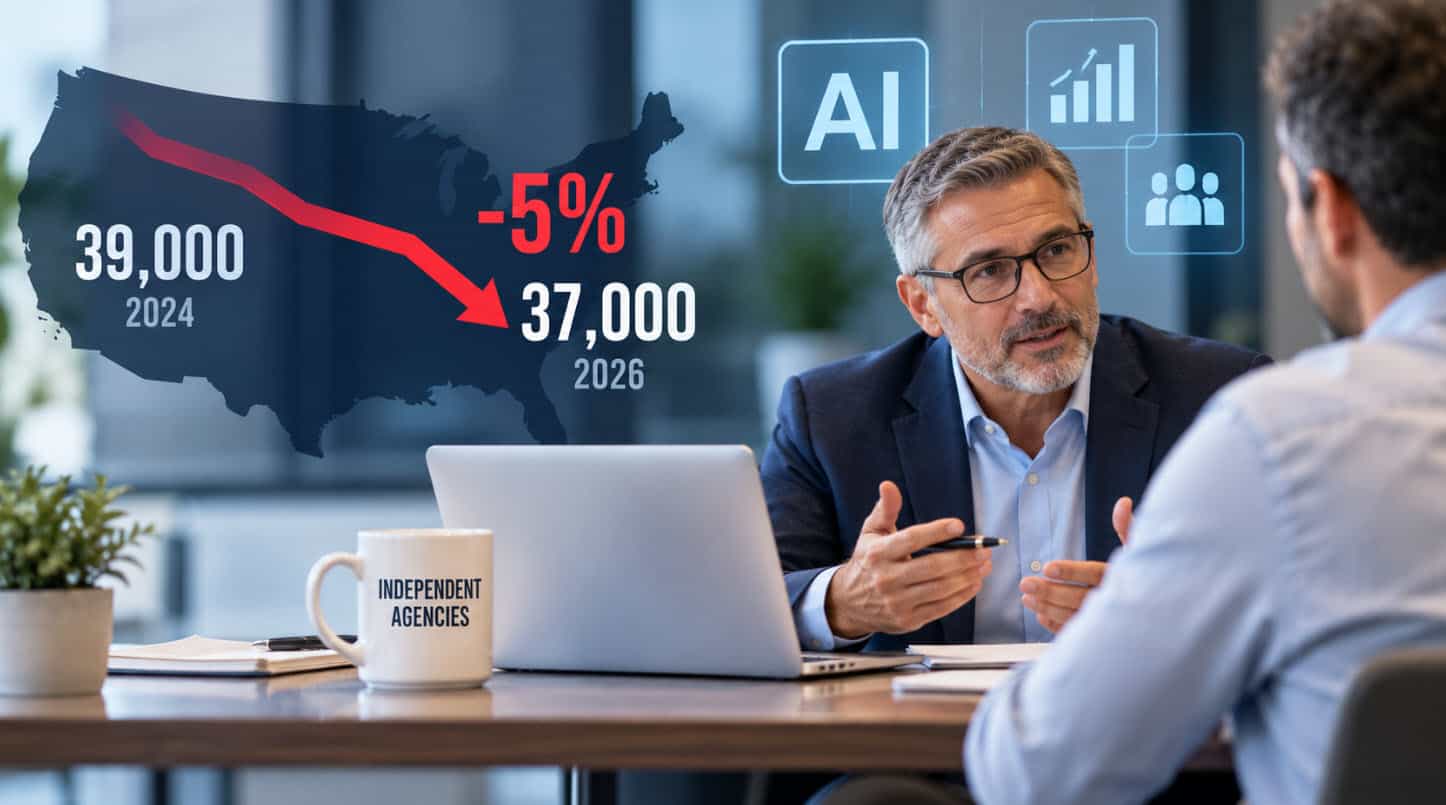
The estimated number of independent agencies declined to 37,000 in 2026, while AI adoption among agencies surged since 2024
Two thousand agencies have either closed their doors or sold over the past two years. This is a key finding from the latest Agency Universe Study released by Future One in partnership with the Big I. Despite the overall decline, this year’s report also brought good news for insurance agents in the independent agency system. For example, three in four agencies reported revenue increases between 2024 and 2025, while far fewer reported declining revenue.
The study also found increases in staffing and marketing spending, along with a sharp rise in artificial intelligence use. Forty-six percent of agencies reported using AI in 2026, compared with 15% in 2024.
First published in 1983, the Agency University Study takes an unparalleled look at the current state of the independent agency system in the U.S. by reviewing an array of statistics, including numbers, revenue base and sources, number of employees, ownership, mix of business, diversification of products, technology uses, non-insurance income sources, and marketing methods. Since 2002, it has been conducted biennially, and since 2004 it has relied on internet data collection.
The 2026 study included 1,376 respondents and was conducted by Zeldis Research in cooperation with Future One.
“The Agency Universe Study remains the most empirical look at the largest insurance distribution channel in America: the independent agency channel,” says Jennifer Becker, Big “I” senior director of agent development, research, and education. “This year’s study provides a unique barometer on the agency system as it evolves around technology, softer markets, and perpetuation.”
Independent Agency Count Continues to Decline
According to the latest data, the estimated number of independent insurance agencies fell approximately 5.1% over the past two years. Future One estimates there were 37,000 independent insurance agencies in the United States in 2026, down from 39,000 in 2024. This decline reflects the continued downward trend in the total number of independent agencies in the U.S. over the past four years. In 2024, the Agency Universe study estimated there were 39,000 independent P&C agents and brokers, down from 40,000 in 2022.
Interestingly, the 2024 study noted that mergers and acquisitions activity and perpetuation challenges would continue to affect the agency channel, with one in three agencies expecting an ownership change within five years.
Comparatively, however, the 2026 study describes the latest reduction as a small decrease, stating that the total number of agencies has remained relatively stable over the past decade
Revenue Growth Remains Widespread
Revenue growth remained broad across the independent agency channel. Three in four agencies reported higher revenue between 2024 and 2025, roughly matching the prior 2024 survey, while the share reporting declines fell to 8% from 12%.
The gains extended across both major business segments. About seven in 10 agencies reported higher personal lines revenue, and roughly two-thirds reported higher commercial lines revenue. The study also noted that most agencies were profitable in both personal and commercial lines, although it did not provide a specific profitability percentage.
Average Agency Staffing Increases
Although the total number of independent agencies has decreased, those still operating are doing business with larger staffs. The average agency reported 9.9 employees across all positions in 2026, up from the 8.2 reported in 2024.
However, the growth was not evenly distributed. One in three agencies said they added employees in the past two years, with jumbo agencies most likely to increase headcount and small agencies least likely.
AI Use Rises to 46% of Agencies
AI use among independent agencies has surged since 2024. Barely registering in the previous Agency Universe Study, when only 15% claimed to use it, AI has quickly moved into the mainstream of agency operations, with 46% of agencies reporting use in 2026.
Regarding how agents used AI in their agencies, 49% said they used it for marketing content generation, 43% for coverage form analysis, and 35% for contract reviews.
The rapid adoption of artificial intelligence has also brought new concerns to agencies. Sixty percent of agencies cited limited knowledge of AI capabilities as a barrier to adoption, while 48% pointed to security and privacy concerns. Both measures were 10% higher than in 2024. Keeping pace with AI developments was also a leading industry challenge, cited by 43% of respondents.
Hiring and Personal Lines Among Leading Challenges
Hiring remained the most commonly cited challenge for independent agencies, with 45% of respondents pointing to the difficulty of finding and screening candidates with strong potential.
Technology concerns were a close second. Forty-three percent cited keeping up with AI, while 41% identified growing personal lines business as a challenge. At the same time, concern over carriers’ commitment to the market eased, falling to 41% from 56% in 2024.
Among technology-related issues, agencies continued to rank dealing with multiple carrier interfaces as their biggest challenge.
Marketing Budgets Rise
Independent agencies are also investing more in marketing. The average agency marketing budget more than doubled over the past two years, rising to $20,600 in 2026 from $14,300 in 2024.
Digital channels also continue to dominate those efforts. Social media and digital marketing ranked as the top activity for 47% of agencies, followed by Google Business, search engine optimization, and agency websites.
Facebook remained the most widely used social platform, with 70% of agencies surveyed saying they engaged with the platform. Instagram was second at 46%, followed by LinkedIn at 35%.
Agencies Continue to Emphasize the “Human Touch”
Even as agencies adopt more technology, most still want customer service to remain centered on the agency. Eighty-six percent of agents said they preferred customers to work through the agency by telephone or other non-online methods, while fewer than one in four favored self-service through a carrier website or app.
Agencies were more comfortable with self-service for routine functions such as accessing policy documents, billing and claims than for obtaining quotes or purchasing coverage.
Customer experience is also receiving more attention. Fifty-seven percent of agencies said they had increased their focus on it, and the same share said CSRs and producers need more training to sell on value rather than price.
“Independent agencies are successfully navigating a changing insurance landscape and the surge of AI,” said Charles Symington, Big “I” president & CEO. “This study illustrates a distribution channel that remains stable, resilient, and well-positioned for the future. As the market evolves, agencies are investing in AI and other technologies without losing sight of what distinguishes the channel: trusted advice, choice and personal relationships.”