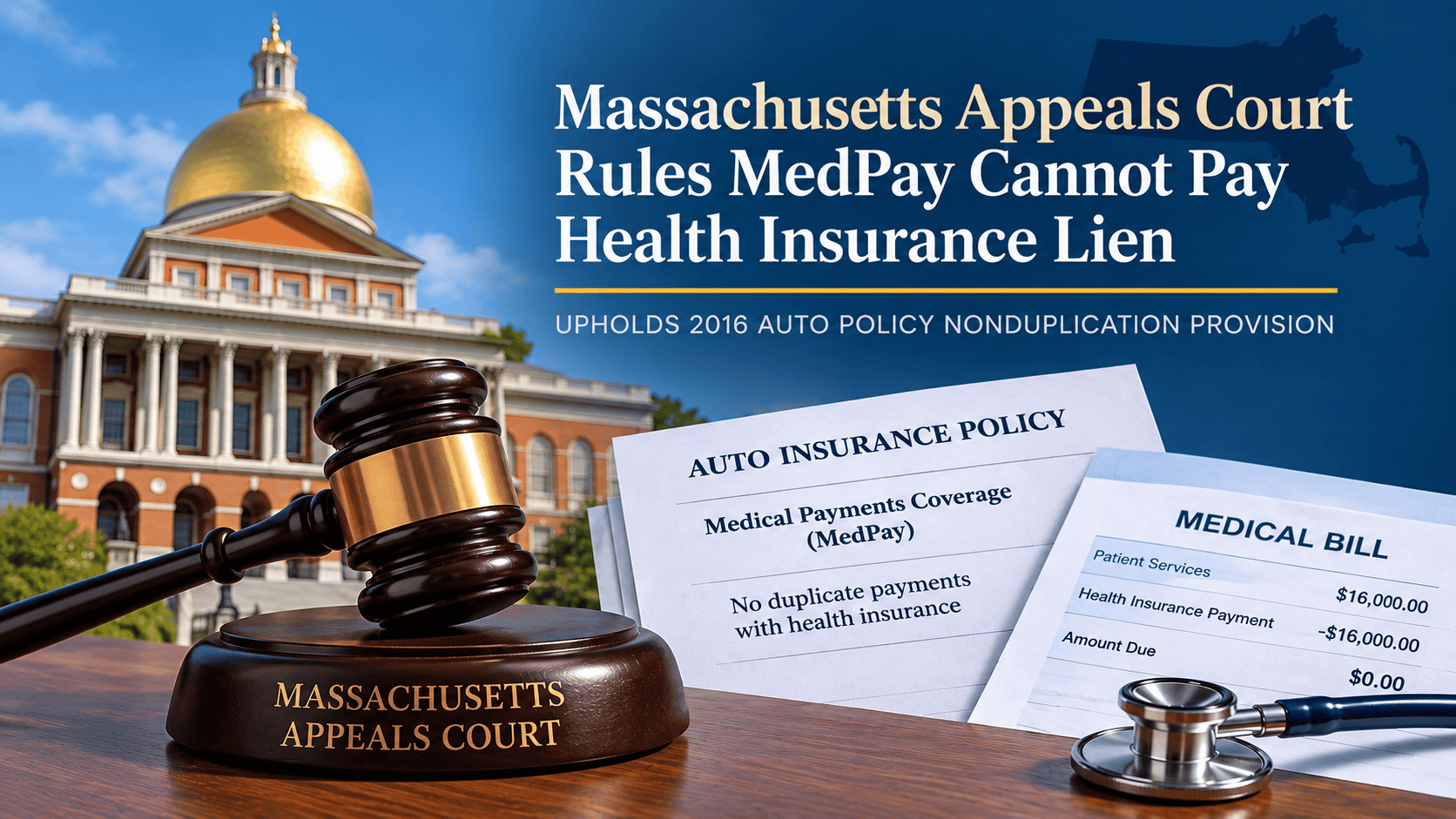
The Massachusetts Appeals Court has upheld the MedPay nonduplication provision in the 2016 Standard Massachusetts Automobile Insurance Policy, which bars Medical Payments coverage when the same medical expenses have already been covered and paid by health insurance.
In a September 4, 2026 decision, Noellen Bousquet v. Commerce Insurance Company, the Appeals Court affirmed a judgment for Commerce Insurance Company. The insured used proceeds from a third-party settlement to reimburse her health insurer for accident-related medical bills. The dispute was whether she could then recover MedPay benefits for those expenses.
Writing for a three-judge panel, Justice Joseph M. Ditkoff Neyman concluded that the 2016 policy’s nonduplication provision does not conflict with G.L. c. 175, § 113C, which requires Massachusetts automobile insurers to offer optional MedPay coverage of at least $5,000.
The decision also explains how the 2016 policy language changed the result reached by the Supreme Judicial Court under an earlier version of the standard auto policy in Golchin v. Liberty Mutual Insurance Co., 466 Mass. 156 (2013).
$25,000 in MedPay and a Health Insurance Lien
Noellen Bousquet was injured in a July 2018 automobile accident and incurred more than $16,000 in medical expenses. At the time, she had health insurance through Fallon Community Health Plan and a standard Massachusetts automobile policy issued by Commerce.
The Commerce policy provided PIP coverage under Part 2, and Bousquet had purchased $25,000 in optional MedPay coverage under Part 6.
Commerce paid $2,000 in PIP benefits, after which Bousquet was required to coordinate benefits with Fallon. Fallon paid her additional medical expenses.
Bousquet later sued the driver responsible for the accident. Fallon, through its subrogation agent, asserted a $13,429.62 lien against her recovery under G.L. c. 111, § 70A. Bousquet settled the underlying action and satisfied Fallon’s lien from the settlement proceeds.
She then sought MedPay benefits from Commerce.
The 2016 Policy’s Nonduplication Provision
Part 6 of the 2016 standard policy covers reasonable expenses for necessary medical and funeral services resulting from an accident but contains an express nonduplication provision.
Among other limitations, Part 6 provides that no MedPay payment will be made when it would duplicate a payment for the same bodily injury under a health insurance policy covering the injured person.
The Division of Insurance’s 2016 coordination-of-benefits regulation similarly provides that MedPay under a motor vehicle policy is secondary to and in excess of health-plan and PIP benefits.
The Worcester District Court entered judgment for Commerce. The Appellate Division of the District Court affirmed, and Bousquet appealed.
Why Golchin Did Not Control the Result
Bousquet argued that § 113C required insurers to offer MedPay and that the Commissioner exceeded his authority by approving policy language restricting that coverage when health insurance had paid the medical expenses.
The Appeals Court disagreed.
Section 113C requires automobile insurers to offer MedPay coverage of at least $5,000, the Court said, but the statute does not prohibit the Commissioner from defining or limiting the scope of that coverage. In the absence of a legislative requirement for duplicative MedPay recoveries, the relevant policy language was within the Commissioner’s discretion.
The Court then turned to the SJC’s 2013 Golchin decision.
Under the pre-2016 standard policy involved in Golchin, an insured could recover MedPay despite health insurance payments because the policy contained no exclusion or limitation addressing medical expenses also covered by health insurance.
But the SJC also explained that insurers could petition the Division of Insurance to change the standard policy language to prevent that result.
“The 2016 policy revisions reflect that clarification,” the Appeals Court said.
Because the revised policy expressly created the nonduplication provision contemplated in Golchin, the Court concluded that it did not conflict with § 113C.
Commissioner’s Authority Has Limits
The Court did not hold that the Commissioner has unlimited authority to restrict MedPay.
It expressly noted that the Commissioner’s authority “is not unbounded” and cited Massachusetts precedent holding that insurance coverage cannot be so unrealistically limited that it lacks substantial economic value.
Bousquet had characterized the current MedPay coverage as “confiscatory,” “illusory,” “a nullity,” and “superfluous.” The Court rejected those arguments as conclusory and unsupported by a developed factual or legal basis.
The Court found that Part 6 does not eliminate MedPay altogether. Rather, the provision prohibits recovery when the insured has already received payment for the same medical expenses under another policy. That limitation, the Court held, did not exceed the permissible bounds on the Commissioner’s authority.
Division Advises Consumers to Consider MedPay With Health Coverage
The Appeals Court also noted the Division of Insurance’s consumer guidance concerning MedPay.
The Division advises consumers to consider carefully whether to purchase MedPay if they already have health insurance because the additional coverage may not be necessary.
The Court emphasized that the Division’s guidance was not determinative of the Commissioner’s authority, but said consumers had been placed on notice that MedPay benefits might not be payable when health insurance was available.
The Appeals Court affirmed the Appellate Division’s decision and order in favor of Commerce.

Owen Gallagher
Insurance Coverage Legal Expert/Co-Founder & Publisher of Agency Checklists
Interested in connecting with me? Call me directly at 617-598-3801.