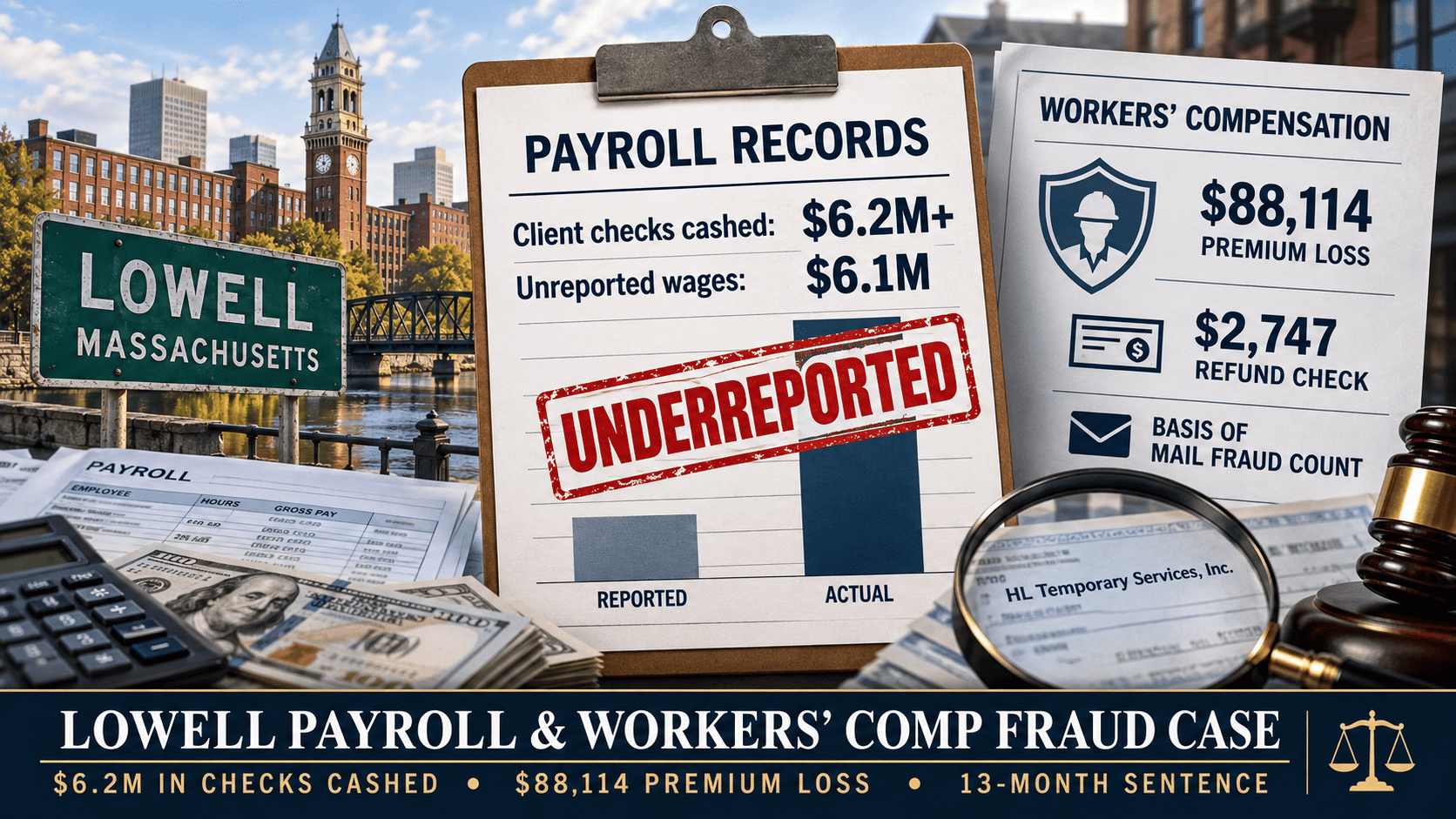
BOSTON — On September 30, 2026, a federal judge sentenced Henry Lam, the owner and operator of Lowell-based HL Temporary Services, to 13 months in federal prison following his guilty plea to federal employment-tax charges and mail fraud involving his company’s workers’ compensation insurance.
Chief U.S. District Judge Denise J. Casper imposed the sentence on September 30, 2026, ordering the 68-year-old Lam to serve two years of supervised release following his confinement and pay $1,652,573.31 in restitution. The sentence also included forfeiture and a $1,600 special assessment. Lam is scheduled to report to a Bureau of Prisons facility on November 19, 2026, before 2 p.m.
Lam pleaded guilty on May 27 to all 16 counts of his federal indictment — 15 counts of failure to collect or pay over employment taxes and one count of mail fraud.
More Than $6.2 Million in Client Checks Cashed
According to federal court filings, Lam operated HL Temporary Services as a Lowell temporary employment agency serving more than 20 clients between 2016 and 2023. The U.S. Attorney’s Office said the company served client businesses in New England, including a seafood processor, a garden center and a sheet metal fabricator.
Between the first quarter of 2016 and the third quarter of 2023, Lam cashed more than 1,500 client checks totaling more than $6.2 million at Massachusetts check-cashing businesses, despite maintaining a business checking account.
Lam used the proceeds to pay employees in cash, while some wages were paid by check through a payroll processor. According to the government’s sentencing memorandum, he filed quarterly IRS Forms 941 reporting the check wages but not the cash wages.
The government calculated the resulting federal tax loss at more than $1.5 million. Prosecutors also said Lam continued the conduct after IRS Criminal Investigation agents interviewed him in March 2022.
Workers’ Compensation Premium Loss Totaled $88,114
The same payroll concealment affected HL Temporary Services’ workers’ compensation insurance.
The indictment states that workers’ compensation premiums were based in part on an employer’s payroll and that insurers commonly conducted audits after policy terms to determine actual payroll.
According to federal filings, Lam supplied false payroll journals and tax records that substantially understated HL Temporary Services’ payroll and falsely described the type of work performed by employees.
The government calculated that the false information deprived the workers’ compensation insurer of $88,114 in premiums between 2015 and 2022.
The indictment alleges that the insurer issued premium-adjustment notices reflecting lower premiums than Lam should have owed, along with refund checks for premiums the insurer had been led to believe HL Temporary Services had overpaid.
One of those refunds became the basis of the mail-fraud charge.
$2,747 Premium Refund Formed Basis of Mail Fraud Count
Count 16 charged Lam with mail fraud arising from a workers’ compensation insurance premium refund check for $2,747 issued on or about April 1, 2021.
The indictment alleged that the check was issued by the company administering the workers’ compensation policies and made payable to Lam doing business as HL Temporary Services.
Lam pleaded guilty to that count along with the 15 employment-tax charges.
Federal filings also state that HL Temporary Services carried no workers’ compensation insurance from January 2022 through the third quarter of 2023. Lam nevertheless continued operating the agency and cashed more than $1.2 million in client checks during that period.
Government Had Sought 15-Month Sentence
The U.S. Attorney’s Office had recommended that Lam receive 15 months in prison, two years of supervised release and total restitution of $1,652,573.31 — consisting of $1,564,459.31 to the IRS and $88,114 to the workers’ compensation insurer.
The government’s requested sentence was below the 18-to-24-month Guidelines range described in its sentencing memorandum.
In advocating imprisonment, prosecutors argued that accurate payroll reporting is important both to tax enforcement and to workers’ compensation insurers.
“Workers rely on their employers’ compliance with workers’ compensation insurance mandates, as do the insurance companies who spread the risk by insuring many different employers,” the government wrote.
Massachusetts Temporary-Agency Cases Cited
The government also cited five other District of Massachusetts cases involving temporary-employment agency operators convicted of tax offenses. The sentences identified in those cases ranged from 12 months and one day to 24 months.
Prosecutors acknowledged that comparisons among criminal cases are inherently imperfect but argued that the cases supported a prison sentence in Lam’s case.
The U.S. Attorney’s Office said IRS Criminal Investigation investigated the matter with assistance from the Insurance Fraud Bureau of Massachusetts.