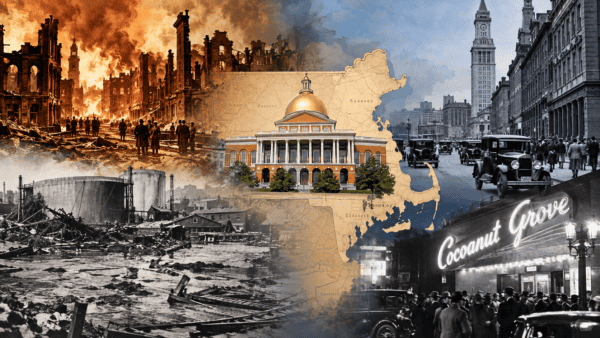
As the insurance industry gathers for the 2026 MAIA Big Event to celebrate America’s 250th anniversary, a look back at five events that helped shape Massachusetts property and casualty insurance.
The Massachusetts Association of Insurance Agents’ 2026 Big Event celebrates 250 years of American independence and the enduring role of independent insurance agents. The anniversary also provides an opportunity to look back at the Commonwealth’s contributions to the development of the American insurance industry.
From catastrophic fires and an extraordinary industrial accident to the founding of a national insurer and the introduction of compulsory automobile insurance, Massachusetts has played an important role in shaping insurance practices and regulation.
Some of those developments originated with legislation. Others arose from disasters that exposed the financial consequences of property damage, personal injuries, and inadequate safety precautions.
Here are five events that helped shape Massachusetts insurance history.
1. The Great Boston Fire of 1872: A Catastrophe That Bankrupted Insurers
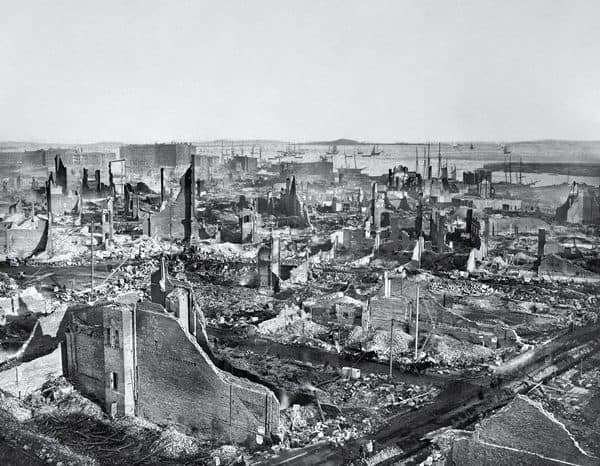
On November 9, 1872, a fire broke out in a commercial building on Summer Street in downtown Boston. By the time the flames were brought under control the following day, the fire had destroyed approximately 776 buildings across 65 acres of the city’s commercial district.
Property losses were estimated at $75 million (approximately $2.1 billion in 2026 dollars), an extraordinary amount for the period.
The catastrophe devastated businesses, destroyed inventories and buildings, and caused several fire insurance companies to become insolvent.
The fire also exposed weaknesses in Boston’s firefighting infrastructure. The city’s water supply and fire protection systems had not kept pace with commercial development, while an epidemic affecting horses complicated the movement of firefighting equipment.
The disaster demonstrated the consequences of geographically concentrated property risks and the potential for a single catastrophic event to overwhelm insurers’ financial resources.
It also contributed to changes in fire protection and building safety practices.
The Boston Public Library’s historical account documents the destruction and the resulting insurance company failures.
2. The Founding of Liberty Mutual in 1912: Workers’ Compensation Creates a Major Insurer
The enactment of Massachusetts’ workers’ compensation legislation in 1911 provided the foundation for the creation of one of the country’s largest property and casualty insurance organizations.
In January 1912, a group of Massachusetts industrial executives established the Massachusetts Employees Insurance Association to provide workers’ compensation insurance under the state’s new statutory system.
The company began operations in July 1912 and adopted the name Liberty Mutual Insurance Company in 1917.
Over the following decades, Liberty Mutual expanded beyond workers’ compensation into automobile insurance and other lines of property and casualty coverage, eventually developing into a major international insurance organization.
The company’s history illustrates how the creation of a new statutory insurance market can lead to the development of insurers whose operations extend well beyond the coverage that prompted their formation.
A historical account of the company’s formation and early years appears in the Massachusetts Division of Insurance’s 1989 annual report.
3. The Great Molasses Flood of 1919: A Disaster That Produced Years of Liability Litigation
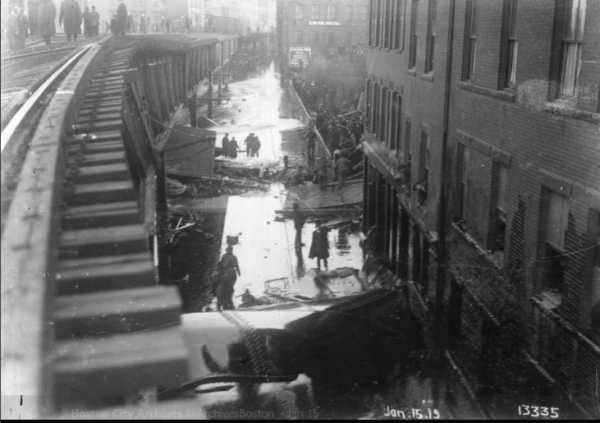
On January 15, 1919, a massive steel storage tank ruptured in Boston’s North End, releasing approximately 2.3 million gallons of molasses into the surrounding neighborhood.
The resulting wave swept through streets and buildings, damaging railroad infrastructure, destroying property, killing 21 people, and injuring approximately 150 others.
The tank had been constructed for Purity Distilling Company, a subsidiary of United States Industrial Alcohol Company.
The disaster generated extensive litigation involving personal injuries, deaths, and property damage. Numerous claims were consolidated into legal proceedings against United States Industrial Alcohol.
Following years of litigation, the company was held responsible for the tank’s failure and resulting damages.
The proceedings became an early example of large-scale litigation involving industrial negligence and multiple claimants.
For the insurance industry, the accident illustrates the type of industrial exposure that can generate substantial bodily injury and property damage liability claims from a single occurrence.
The City of Boston’s historical account includes photographs and details of the disaster.
4. Massachusetts Enacts America’s First Compulsory Automobile Liability Insurance Law in 1925
As automobile ownership increased during the early twentieth century, Massachusetts became the first state to establish a compulsory motor vehicle liability insurance or financial security requirement.
The Legislature enacted the law in 1925, and it became applicable to automobile registrations beginning in 1927.
The legislation required vehicle owners to demonstrate financial responsibility for bodily injuries arising from the operation of their automobiles.
The original law provided for minimum liability limits of at least $5,000 (approximately $97,000 in 2026 dollars) for injury or death to one person and $10,000 (approximately $194,000 in 2026 dollars) for an accident involving injuries or deaths to multiple people.
Vehicle owners could satisfy the requirement through an automobile liability insurance policy, a surety bond, or a deposit of $5,000 in cash or approved securities with the Commonwealth.
The distinction is important: although the law became known as the compulsory automobile insurance law, it did not require every vehicle owner to purchase an insurance policy.
Nevertheless, the legislation established a new relationship between motor vehicle registration and liability protection and became an important precedent for compulsory automobile insurance and financial responsibility laws adopted elsewhere.
A detailed contemporary account appears in the Casualty Actuarial Society’s 1926–1927 Proceedings.
5. The Cocoanut Grove Fire of 1942: A Catastrophe That Changed Fire Safety Standards
On November 28, 1942, a fire swept through Boston’s Cocoanut Grove nightclub, killing 492 people in one of the deadliest building fires in American history.
The fire spread rapidly through the crowded nightclub. Combustible interior decorations contributed to its progression, while inadequate or obstructed exits prevented many patrons from escaping.
The catastrophe led to extensive examinations of building and fire safety requirements and contributed to changes governing emergency exits, door operation, interior decorations, and other life safety measures.
For commercial property and liability insurers, the disaster demonstrated the importance of occupancy hazards, fire protection systems, emergency egress, and building inspections in evaluating commercial risks.
The tragedy also influenced the development of fire safety standards that continue to affect the inspection and underwriting of commercial properties.
The National Fire Protection Association identifies Cocoanut Grove as the deadliest nightclub fire in its historical records.
Four More Milestones in Massachusetts Insurance History
Although these five events provide examples of the Commonwealth’s insurance history, several other developments deserve recognition.
1852 — Massachusetts Establishes an Insurance Regulatory Agency
Massachusetts established its Board of Insurance Commissioners under Chapter 311 of the Acts of 1852. The original board consisted of the Commonwealth’s secretary, treasurer, and auditor, who were responsible for examining insurance company financial statements and investigating insurers.
The legislation established a foundation for the state’s insurance regulatory system, including financial oversight and solvency supervision.
1968 — Creation of the Massachusetts FAIR Plan
The Massachusetts Legislature established the Massachusetts Property Insurance Underwriting Association, commonly known as the FAIR Plan, under Chapter 731 of the Acts of 1968.
Originally designed to make property insurance available in designated urban areas, the FAIR Plan’s operations were extended statewide in 1970.
The association remains an important component of the Massachusetts property insurance residual market.
1971 — Massachusetts Introduces the Nation’s First No-Fault Automobile Insurance System
Massachusetts enacted Chapter 670 of the Acts of 1970, establishing a no-fault automobile insurance system effective January 1, 1971.
The legislation required Personal Injury Protection benefits, initially limited to $2,000, and restricted certain tort claims arising from automobile accidents.
The Supreme Judicial Court upheld the legislation in Pinnick v. Cleary, 360 Mass. 1 (1971), a decision addressing the constitutionality of the new system.
2008 — Massachusetts Introduces Managed Competition in Automobile Insurance
On April 1, 2008, Massachusetts replaced its longstanding system of commissioner-established private passenger automobile insurance rates with managed competition.
Under the new system, insurers could develop their own rates and rating plans, subject to regulatory oversight.
The reform also began the transition to the Massachusetts Automobile Insurance Plan, changing how high-risk drivers were assigned to insurers.
It represented one of the most substantial structural changes in the Massachusetts automobile insurance marketplace since the introduction of compulsory coverage.
A History That Continues to Shape the Massachusetts Insurance Marketplace
Massachusetts’ insurance history encompasses much more than the formation of insurance companies or the adoption of new laws.
It includes catastrophes that tested insurers’ financial resources, industrial accidents that produced extensive liability litigation, and legislative initiatives that established new approaches to insurance coverage and regulation.
The Great Boston Fire, the founding of Liberty Mutual, the Molasses Flood, compulsory automobile insurance, and the Cocoanut Grove fire illustrate how different events influenced the development of property and casualty insurance.
As the Massachusetts insurance industry gathers for the 2026 MAIA Big Event to celebrate 250 years of American independence, these historical milestones offer a look at some of the developments that helped create the insurance marketplace in which today’s independent agents and insurers operate.