Twenty-five states have adopted laws or regulations governing third-party litigation financing, an industry that has grown into a multi-billion-dollar source of capital for lawsuits. Massachusetts may join them under proposed legislation requiring plaintiffs and their attorneys to disclose litigation financing arrangements to opposing parties and liability insurers defending lawsuits.
Senate Bill 680, sponsored by Senator Nick Collins, would establish disclosure requirements for commercial and consumer litigation financing, regulate funding companies, and limit charges on advances made to individual claimants.
The bill was reported favorably by the Joint Committee on Financial Services and referred to Senate Ways and Means on January 8, 2026. As of November 16, 2026, it remains pending before that committee.
The proposed legislation comes as Property and Casualty insurers increasingly question the influence of outside litigation financing on claim settlements, litigation expenses, and rising casualty insurance costs.
The Insurance Information Institute (Triple-I) and the American Property Casualty Insurance Association (APCIA) have advocated greater transparency concerning third-party financing arrangements. Supporters of litigation funding, meanwhile, maintain that it enables individuals and businesses lacking financial resources to pursue legitimate claims.
How Third-Party Litigation Financing Works
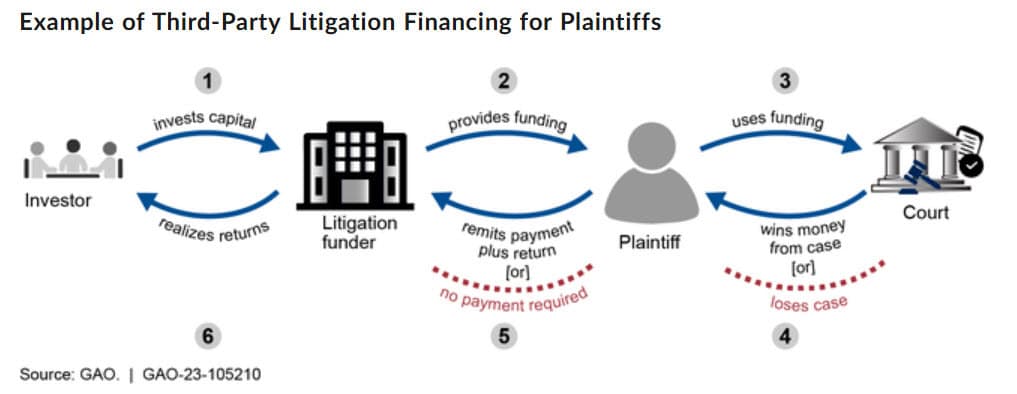
Third-party litigation financing involves an outside investor or company providing money to a claimant, attorney, or law firm in exchange for repayment tied to the outcome of a lawsuit.
Many arrangements are non-recourse, meaning the investor receives no repayment if the underlying claim produces no recovery, subject to the financing agreement’s terms.
The industry generally operates through two types of financing.
Consumer litigation funding provides advances directly to individuals pursuing legal claims, frequently involving personal injuries.
For example, someone injured in an automobile accident may obtain money for household expenses while awaiting settlement of a bodily injury claim. The funding company receives repayment from the eventual settlement or judgment, together with agreed charges.
Those charges can accumulate while litigation continues, reducing the claimant’s ultimate recovery.
Commercial litigation financing involves investments in individual lawsuits, groups of cases, or law firm portfolios. The money may finance expert witnesses, discovery, litigation expenses, and other costs associated with pursuing claims.
These arrangements can involve substantially larger financial commitments than consumer advances.
A Multi-billion-Dollar Industry
Third-party litigation financing has developed into a substantial investment business.
According to Westfleet Advisors, which researches the U.S. commercial litigation financing market, industry assets under management increased from approximately $9.5 billion in 2019 to $16.1 billion in 2024.
New commercial litigation financing commitments declined during 2023 and 2024 before rebounding in 2025.
Westfleet reported that investors committed approximately $2.8 billion to new commercial litigation financing transactions in 2025, an increase of 23% from the $2.3 billion reported in 2024.
The figures measure different aspects of the market. Assets under management include capital allocated to existing and potential investments, while annual commitments measure new financing activity. Westfleet discontinued reporting aggregate industry assets under management in its 2025 study.
The research also excludes consumer litigation advances and mass-tort law firm financing, meaning the figures do not represent the entire litigation financing market.
Why Litigation Financing Concerns P&C Insurers
For Property and Casualty insurers, the principal concern is whether outside financing affects the cost, duration, and settlement of liability claims.
Consider a Massachusetts business insured under a commercial general liability policy.
A customer suffers a serious injury on the business’s premises and brings a lawsuit. The insurer undertakes the defense and evaluates the claim for settlement.
If the claimant or the claimant’s attorney has obtained outside financing, the arrangement may introduce additional financial considerations into settlement negotiations.
A consumer claimant may have accumulated substantial repayment obligations. A commercial litigation funder may have a contractual financial interest in the lawsuit’s outcome.
Depending on the agreement, these interests could influence the claimant’s willingness to accept a settlement.
Insurance industry organizations argue that litigation financing can prolong lawsuits, increase defense expenses, and contribute to larger settlement demands.
These concerns are part of the broader insurance industry discussion of social inflation, a term generally used to describe increases in liability claim costs attributable to factors beyond ordinary economic inflation.
Litigation financing companies dispute the suggestion that their involvement necessarily increases litigation costs. They maintain that financing allows claimants to pursue cases against better-funded defendants without having to accept settlements because of immediate financial pressures.
The effect on any particular lawsuit depends on the circumstances and financing agreement. Nevertheless, insurers maintain that knowing whether outside investors are financing litigation can matter in their evaluation of liability claims.
Massachusetts Abolished Champerty Nearly 30 Years Ago
Massachusetts has an important place in the legal development of litigation financing.
Under the common-law doctrine of champerty, agreements where outsiders financed lawsuits in exchange for a share of any proceeds were prohibited.
In 1997, the Massachusetts Supreme Judicial Court abolished the doctrine of champerty in Saladini v. Righellis, 426 Mass. 231.
The SJC concluded that the traditional prohibitions were no longer necessary because existing legal remedies could address litigation misconduct and unfair financial arrangements.
The decision did not eliminate judicial scrutiny of financing agreements. Courts retained the authority to examine challenged arrangements for unfairness, excessive charges, and improper financial overreaching.
The decision left Massachusetts without the historical common-law prohibition against third-party litigation financing.
Senate Bill 680 would establish specific statutory requirements governing these transactions.
Twenty-Five States Have Adopted Litigation Funding Regulations
Regulation of third-party litigation financing has expanded across the country.
According to the Federal Insurance Office’s September 2026 Annual Report on the Insurance Industry, 25 states now have laws or regulations governing litigation financing, with significant differences in their approaches.
Four states—California, New Hampshire, New York, and North Carolina—adopted new measures after August 2025, while Arizona and Ohio made substantial changes to their existing rules.
North Carolina became the first state to broadly prohibit third-party litigation investments when Governor Josh Stein signed the Prohibit Litigation Investments Act on June 22, 2026.
The law prohibits arrangements in which outside investors provide money for litigation expenses in exchange for repayment contingent on the outcome of a civil proceeding. It contains exceptions for contingent attorney fees, insurance defense obligations, certain nonprofit legal services, and financing for personal or household expenses not used to pay litigation costs.
Closer to Massachusetts, New Hampshire enacted legislation in July 2026 restricting commercial litigation financing involving foreign persons, entities, or countries. The law takes effect January 1, 2027.
Other states have taken less restrictive approaches. Arizona requires disclosure of the existence of certain litigation funding agreements, while New York has adopted consumer financing protections and restrictions.
Massachusetts’ proposed legislation would regulate litigation financing rather than broadly prohibit it. Its principal provisions for insurers concern disclosure of financing arrangements involving claims against their insureds.
The national legislative developments are detailed in the Federal Insurance Office’s September 2026 report, pages 46–48.
Massachusetts Bill Would Require Disclosure to Liability Insurers
Senate Bill 680, titled An Act to Provide Transparency in Third Party Litigation Financing, would establish a new Chapter 167K of the Massachusetts General Laws.
The proposal would require consumer litigation funding companies and commercial litigation financiers to register with the Massachusetts Division of Banks and comply with specified disclosure and regulatory requirements.
Its most important provisions for liability insurers address access to information about financing arrangements.
Commercial litigation financing disclosures
Under the legislation, parties or their attorneys would have to provide copies of covered commercial litigation financing agreements to opposing parties and insurers with a duty to defend another party in the proceeding.
Disclosure would be required without waiting for a discovery request.
The legislation also specifies that commercial litigation financing agreements would be admissible evidence at trial.
Consumer litigation financing disclosures
The proposal establishes different requirements for individuals obtaining advances against anticipated litigation recoveries.
A plaintiff or the plaintiff’s attorney would have to provide written notice of a consumer funding agreement to opposing parties and insurers responsible for defending them within 30 days after execution.
Unlike commercial financing agreements, consumer contracts would not automatically have to be produced with the notice. However, their contents would expressly be subject to discovery.
The written notice itself would be presumed inadmissible at trial, subject to rebuttal.
Limits on charges and funder control
The legislation would limit annual charges on consumer litigation funding to 36%, plus a permitted one-time document preparation fee. Contracts exceeding the statutory rate would be treated as usurious under G.L. c. 271, § 49.
Consumers would also have ten business days to cancel a funding agreement without penalty by returning the money advanced.
The proposal would prohibit litigation financiers from controlling litigation strategy, legal representation, or settlement decisions.
These provisions are contained in the official text of Senate Bill 680.
The legislation has not been enacted, and its proposed requirements are not currently effective.
What Litigation Financing Means for Massachusetts Insurance Agencies
Although litigation financing primarily concerns plaintiffs, attorneys, and liability insurers, it has implications for Massachusetts personal and commercial lines insurance.
Personal automobile insurance: Automobile insurers defending bodily injury claims could benefit from knowing whether claimants have obtained lawsuit advances. Repayment obligations may influence settlement negotiations, although financing does not independently determine the value of a claim.
Commercial automobile and general liability insurance: Litigation financing may provide plaintiffs and their attorneys with additional resources to pursue substantial claims involving expert testimony, extensive discovery, and prolonged litigation. Increasing claim severity and defense expenses are important considerations in casualty underwriting and pricing.
Umbrella and excess liability insurance: The broader discussion of casualty claim severity reinforces the importance of reviewing liability limits. Commercial umbrella and excess policies, as well as personal umbrellas, can provide additional protection against covered judgments exceeding underlying limits. Appropriate coverage depends on the insured’s individual exposures rather than the existence of litigation financing alone.
Massachusetts’ existing unfair claim settlement requirements would remain unchanged under S.680.
Under G.L. c. 176D, § 3(9)(f), insurers must effectuate prompt, fair, and equitable settlements when liability has become reasonably clear. Violations may also give rise to remedies under G.L. c. 93A when the applicable statutory requirements are satisfied.
The existence of litigation financing does not eliminate these obligations or independently establish an unfair settlement practice.
For insurers defending Massachusetts liability claims, the proposed legislation would provide additional information about outside financial interests in litigation without changing the legal standards governing claim settlement.
A Massachusetts Legislative Issue Worth Watching
The growing number of states regulating third-party litigation financing reflects increased attention to the role of outside capital in civil litigation.
For insurers, the central questions concern transparency, litigation expenses, and the possible influence of financial investors on settlement negotiations.
For claimants, financing can provide resources to pursue legal claims while creating repayment obligations that may reduce their eventual recoveries.
Massachusetts eliminated its common-law prohibition against champerty in 1997. Nearly three decades later, lawmakers are considering statutory requirements for financing companies and mandatory disclosures to liability insurers.
Whether Senate Bill 680 advances remains uncertain. Its consideration places Massachusetts within a broader national debate over how third-party litigation financing should be regulated and what information insurers should receive when defending liability claims.