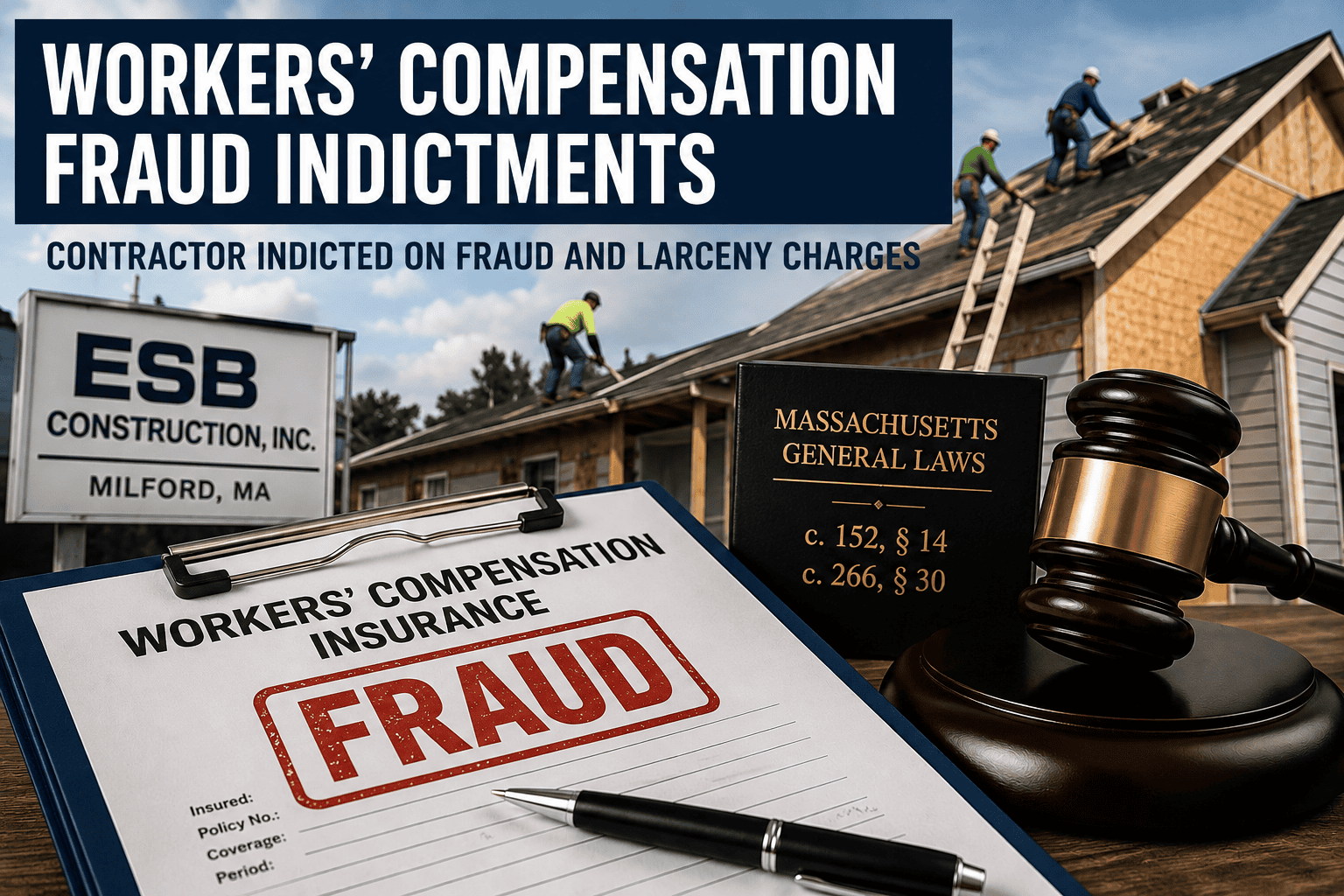
A Worcester grand jury has returned five indictments against Edwin Santiago Bueno, 40, of Milford, the owner of ESB Construction, Inc., in connection with an alleged workers’ compensation insurance premium fraud scheme involving roofing work classified as lower-rated construction work.
According to the Massachusetts Attorney General’s Office, Bueno was indicted on four counts of workers’ compensation insurance fraud and one count of larceny over $1,200. The Attorney General’s announcement stated that Bueno is scheduled to be arraigned in Worcester Superior Court on July 14, 2026.
All charges are allegations. Bueno is presumed innocent unless and until proven guilty.
Attorney General Says Roofing Work Was Classified As Siding Or Painting
The Attorney General’s announcement stated that Bueno owned and operated ESB Construction, Inc., a Milford-based construction company. As the company’s owner, Bueno was responsible for providing workers’ compensation insurance for employees and uninsured subcontractors.
The Attorney General’s Office alleges that, between June 2020 and May 2023, Bueno misclassified subcontractors as siding workers or painters when they were performing roofing work. Under the workers’ compensation rating system, roofing work carries a higher workers’ compensation premium than siding work or painting.
The Attorney General’s Office alleges that, by misclassifying the work performed, Bueno’s company avoided approximately $20,194 in workers’ compensation premiums owed to Ace American Insurance Company for a policy administered by Travelers.
According to the Attorney General’s announcement, Travelers discovered the alleged misclassification and notified the Insurance Fraud Bureau of Massachusetts. The announcement stated that the IFB confirmed that ESB had been performing roofing work while Bueno classified subcontractors under other, lower-rated work categories.
Five Indictments Returned in Worcester Superior Court
The Worcester indictments charge Bueno with:
- Four counts of workers’ compensation insurance fraud under G.L. c. 152, § 14(3); and
- One count of larceny over $1,200 under G.L. c. 266, § 30.
The larceny indictment alleges that, on various dates between June 25, 2020 and May 22, 2023, Bueno, with intent to defraud, obtained by false pretenses money exceeding $1,200 and/or workers’ compensation insurance policies from Ace American Insurance Company for policies administered by The Travelers Indemnity Company.
The four workers’ compensation fraud indictments allege separate dates in 2020, 2021, 2022, and 2023. Each alleges that Bueno knowingly made false or misleading statements, representations or submissions, or knowingly misclassified employees or engaged in deceptive employee leasing practices for the purpose of avoiding full payment of insurance premiums.
Why the Classification Issue Matters
Workers’ compensation premiums are based in part on the type of work performed. A contractor’s payroll classification affects the rate applied to payroll. Higher-hazard work, such as roofing, ordinarily produces a higher workers’ compensation premium than lower-rated work such as siding or painting. This difference can make classification a material premium issue.
The Bueno case also illustrates why uninsured subcontractors are a recurring workers’ compensation underwriting and premium audit issue. If a subcontractor does not provide a valid certificate of workers’ compensation insurance, the subcontractor’s remuneration is included in the general contractor’s workers’ compensation premium calculation, using the job classification applicable to the subcontractor’s work.
For agents, underwriters, and premium audit professionals, the issue is not simply whether a policy was in force. The classification of the work, the status of subcontractors, and the accuracy of payroll and exposure information can determine whether the premium charged reflects the actual risk insured.
Possible Penalties If Convicted
Under G.L. c. 266, § 30, larceny involving property valued over $1,200 may be punished by imprisonment in state prison for not more than five years, or by a fine of not more than $25,000 and imprisonment in jail for not more than two years.
Under G.L. c. 152, § 14(3), workers’ compensation fraud may be punished by imprisonment in state prison for not more than five years, imprisonment in jail for not less than six months nor more than two and one-half years, a fine of not less than $1,000 nor more than $10,000, or both fine and imprisonment.
The workers’ compensation statute also provides that, after conviction, the court shall conduct an evidentiary hearing to determine the financial loss caused by the crime and order restitution for any financial loss sustained by an aggrieved person.
Attorney General’s Office and IFB Investigation
The Attorney General’s Office said the matter is being handled by Assistant Attorney General Elizabeth Valentine and Senior Criminal Investigator Loreny Bernabe of the Office’s Insurance and Unemployment Fraud Division, Victim Witness Advocate Lia Panetta of the Office’s Victim Service Division, and investigators at the Insurance Fraud Bureau of Massachusetts.