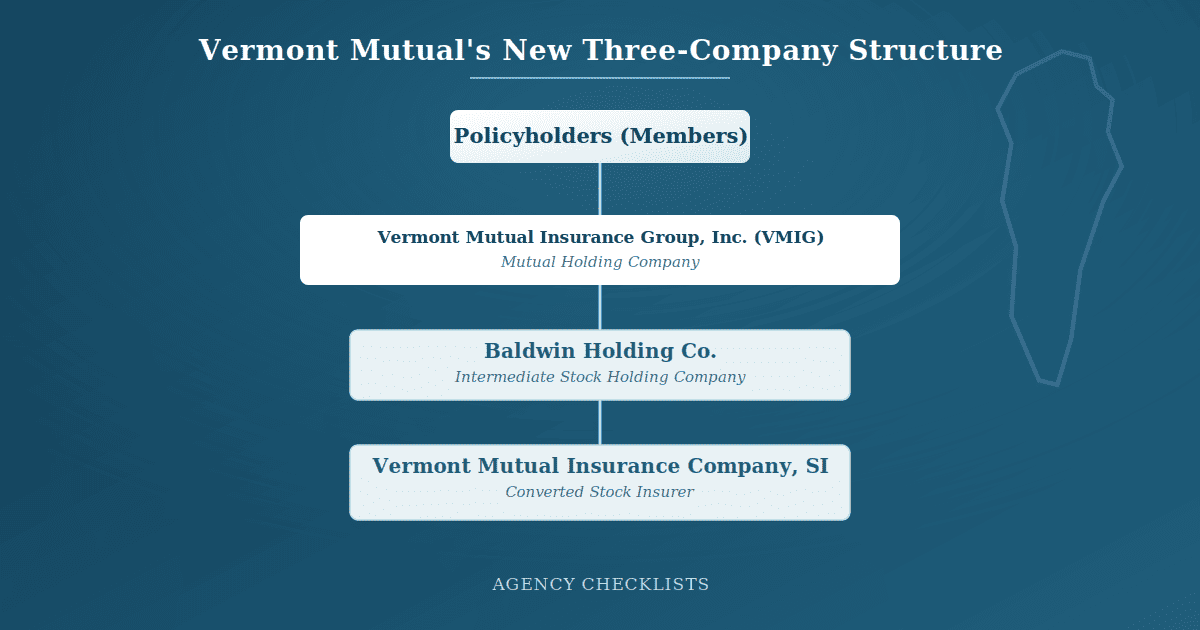
The Commissioner of the Vermont Department of Financial Regulation will hold a public hearing on July 23, 2026, to consider a plan by Vermont Mutual Insurance Company to reorganize into a mutual holding company structure.
Under the plan, adopted unanimously by Vermont Mutual’s board on February 26, 2026, the mutual, chartered in 1828, would, subject to regulatory and policyholder approval, convert into a Vermont stock insurance company, owned by a new intermediate stock holding company, Baldwin Holding, that in turn will be owned by the new mutual holding company whose members will be Vermont Mutual’s policyholders.
The company stresses that the change is structural, not operational. In his cover letter to members, Chair, President, and CEO Mark J. McDonnell wrote that the reorganization will not change a policyholder’s coverage, premium, or the service they receive, and that the group will continue to work through the independent agents who represent it.
The Company’s Financial Strength
Vermont Mutual enters the review from a strong financial footing. On a statutory basis, the company and its subsidiaries reported net income of $127.1 million in 2025 on net premiums earned of $740.5 million, and policyholders’ surplus grew to just over $1.0 billion — up from $840.3 million a year earlier. The group carries an A.M. Best rating of “A” (Excellent) with a stable outlook.
| ($ in millions, statutory basis) | 2025 | 2024 | 2023 |
| Net premiums earned | 740.5 | 675.3 | 560.7 |
| Net income (loss) | 127.1 | 84.3 | (19.0) |
| Total assets | 1,869.7 | 1,648.3 | 1,476.6 |
| Policyholders’ surplus | 1,001.4 | 840.3 | 740.0 |
The company’s cover letter describes Vermont Mutual Insurance Group, including its stock subsidiaries, Granite Security Insurance Company and Northern Security Insurance Company, Inc., as one of the top 50 insurance groups in the country as recognized by Ward Group for the past 18 years, serving more than 320,000 customers across the Northeast.
Vermont Mutual’s Reasons for Reorganizing
Vermont Mutual’s documents indicate that the mutual holding company reorganization would enhance its ability to grow and respond to future needs, challenges, and opportunities in a rapidly changing insurance industry, while preserving mutuality and its focus on policyholders’ long-term interests. More specifically, Vermont Mutual cited several reasons, including providing the company with greater access to capital and other forms of financing.
What It Means for Policyholders and Agents
For the independent agents who place Vermont Mutual business and for their clients, the filing’s central message is continuity. Coverage, premiums, claim handling, and policy benefits are unaffected by the reorganization itself, and every in-force policy remains an obligation of the converted-stock insurer. The company also reaffirms its commitment to continue distributing through local independent agents.
Regulatory Review, the Member Vote, and Key Dates
The plan requires two approvals: the Vermont Commissioner and the members. Under Section 3441, the Commissioner must approve the plan unless he or she makes one of several findings — among them that the proposed reorganization would financially impair the new entities, that the holding company’s resources warrant disapproval, or that the reorganization would be “unfair to the Policyholders.” The members must approve by at least two-thirds of the votes cast, and each policyholder is entitled to a single vote regardless of how many policies they hold.
DOI Hearing on July 23, and Policyholder Vote on September 2
The Insurance Division of the Vermont Department of Financial Regulation will hold a public hearing on July 23, 2026, at 9:30 a.m. in the 3rd-floor OPR Conference Room at 89 Main Street, Montpelier, VT. The hearing is open to Vermont Mutual policyholders and the general public.
The company has scheduled the Special Meeting of Members for September 2, 2026, at 9:00 a.m. at its offices at 335 Industrial Lane, Berlin, Vermont. Eligible members may vote online, by telephone, by mail, or in person; proxies must be received by August 26, 2026. If both approvals are secured, the reorganization becomes effective January 1, 2027.