NAIC Report Finds Surplus Lines Insurers Writing Nearly Two-Thirds of Cyber Premium in US, While Admitted Insurers Focus on Endorsement Coverage
U.S. cyber insurance premiums returned to growth in 2025, but the market’s loss ratio rose for a second consecutive year as insurers continued reducing rates, according to the National Association of Insurance Commissioners’ latest report on the cybersecurity insurance market.
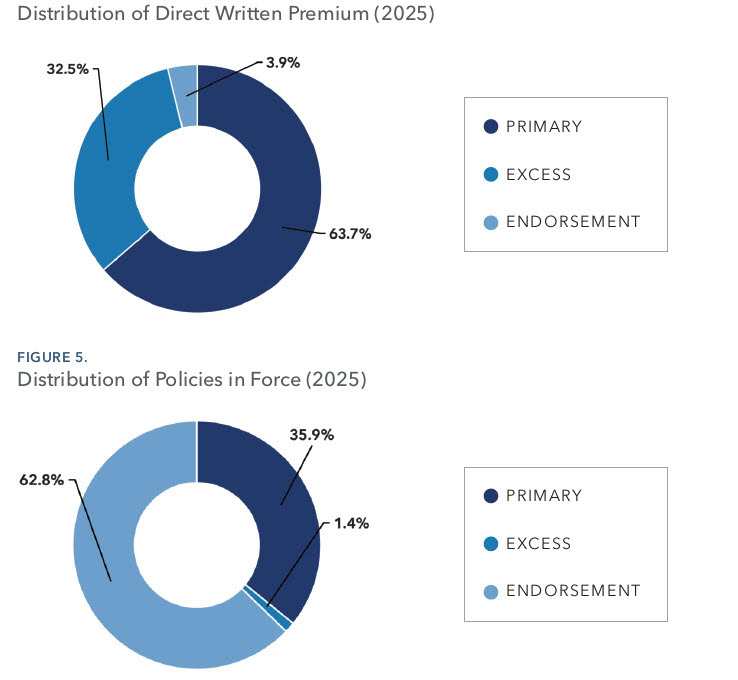
Source: NAIC 2026 Report on the Cybersecurity Insurance Market, Figures 4 and 5, p. 5.
Total U.S. direct written premium, including alien surplus lines, increased approximately 3.5% to $9.46 billion, reversing the previous year’s decline. Domestic policies in force increased approximately 33% to 5.84 million, while reported claims rose 20% to 56,323.
The industry-wide cyber loss ratio climbed to 53% from 48.7% in 2024, reaching its highest level since the pandemic-era ransomware surge. Meanwhile, the first quarter of 2026 marked the eighth consecutive quarter of U.S. cyber rate reductions.
Cyber Insurance Premium Growth Returns as Loss Ratios Rise
On October 21, 2026, the NAIC’ issued its “Report on the Cybersecurity Insurance Market” for reporting year 2025. According to the report. domestic insurers wrote $7.46 billion in cyber direct written premium during 2025, up 5.3% from $7.08 billion in 2024. Alien surplus lines insurers accounted for approximately $2 billion in additional premium.
The report describes a pricing environment in which competition and growing capacity have contributed to continued rate reductions, even as loss ratios have deteriorated.
The deterioration was concentrated in primary cyber coverage, where the loss and defense and cost containment (DCC) ratio increased approximately eight percentage points to 57%. The corresponding ratio for excess cyber coverage improved slightly to approximately 52%.
The report contrasts the current environment with the 2021 hard market, when rising ransomware losses prompted a price correction. It cites concerns that continued rate reductions could test rate adequacy over the intermediate term.
Source: NAIC, 2026 Report on the Cybersecurity Insurance Market, Figures 4 and 5, p. 5.
Surplus Lines Account for Most Cyber Premium
Surplus lines insurers represented nearly two-thirds of U.S. cyber direct written premium in 2025.
Domestic surplus lines carriers wrote approximately $4.80 billion, compared with $2.66 billion for admitted insurers. Alien surplus lines carriers accounted for another $2 billion.
The NAIC describes an increasingly distinct division between the surplus lines market, which focuses on primary and excess cyber-specific policies, and admitted insurers, which concentrate more heavily on endorsements to other commercial policies.
Surplus lines carriers reported a 55.9% incurred loss and DCC ratio, compared with 50.2% for admitted insurers. The report suggests that the higher surplus lines ratio over consecutive years may reflect longer-tail business requiring more time to settle.
Cyber Endorsements Dominate Policy Counts but Not Premium
One of the report’s more significant findings concerns the distribution of cyber coverage.
Endorsements to other commercial policies accounted for 62.8% of domestic cyber policies in force but generated only 3.9% of premium.
By contrast, primary cyber policies represented 35.9% of policies but produced 63.7% of direct written premium. Excess policies represented just 1.4% of policies while accounting for 32.5% of premium.
The loss ratio for endorsement coverage increased from 10.2% in 2024 to 19.1% in 2025, although it remained substantially below the ratios reported for primary and excess coverage.
The figures illustrate the different premium and coverage characteristics of dedicated cyber insurance and endorsements providing more limited protection under other commercial policies.
Chubb Leads Domestic Cyber Insurance Rankings
Chubb Ltd. Group retained its position as the largest domestic cyber insurance group, writing $629.2 million in direct premium and accounting for 8.44% of the market.
Beazley Group moved from 16th to second place with $570.9 million, followed by St. Paul Travelers Group at $543.9 million. Sompo Group and Tokio Marine Holdings completed the top five.
The 10 largest groups accounted for 51.03% of domestic cyber direct written premium, while the top 20 accounted for 76.82%.
Reported loss and DCC ratios varied considerably among leading groups. Beazley recorded a 16.28% ratio, while Starr Group reported 3.75%. Berkshire Hathaway’s ratio was 88.03%.
Liberty Mutual Group ranked 19th, with $161.2 million in direct written premium, a 2.16% market share and a 60.77% loss and DCC ratio.
Large-Account Cyber Claims Become More Expensive
Claims severity increased substantially among large commercial insureds, according to carrier-level data cited in the NAIC report.
For businesses generating at least $1 billion in annual revenue, average cyber claim severity reached approximately $4.4 million in 2025, compared with $2.2 million in 2024. That represented a 586% increase since 2021.
The report attributes the increase principally to business interruption expenses and data breach and privacy-related litigation.
Large-account claim frequency nevertheless declined from approximately 15 claims per 100 policies in 2024 to 10 in 2025.
A separate international claims study covering more than 100,000 policyholders reported a different pattern: overall claims frequency increased 3%, while average claims severity declined 19% to $116,000.
Ransomware remained the costliest claim category in that study, with average severity of $269,000.
Cyber Fraud and Third-Party Exposure Remain Concerns
Business email compromise generated more than $3 billion in reported U.S. losses across 24,768 complaints in 2025, according to FBI figures cited by the NAIC.
The report observes that social engineering and funds transfer fraud losses are frequently excluded or limited under cyber policies, with separate commercial crime coverage potentially responding to those exposures.
It also identifies shared technology infrastructure and third-party service providers as significant accumulation risks because a single incident may affect numerous insureds simultaneously.
For insurance agencies, the report describes a December 2025 compromise of a life insurer’s agent email account involving sensitive policyholder information. The incident was among the breaches discussed in connection with third-party and credential-related exposure.
The report concludes that cyber insurers face continuing pressure from rising claims severity, artificial intelligence-enabled attacks, third-party dependencies and coverage gaps, even as competition maintains downward pressure on pricing.
Read the Full NAIC Cyber Insurance Report
The NAIC’s 2026 Report on the Cybersecurity Insurance Market is available to the public as a free download. The 20-page report provides additional information on cyber insurance premiums, loss ratios, market share, claims trends, and emerging cybersecurity risks, including ransomware, artificial intelligence, and third-party exposures. Readers can access and download the complete report directly from the link her to the NAIC website.