The U.S. Court of Appeals for the First Circuit has asked the Massachusetts Supreme Judicial Court to decide whether automobile insurance policyholders can bring Chapter 93A claims against insurers over practices associated with rates already approved by the state’s Commissioner of Insurance.
In an October 28, 2026, decision, the federal appeals court ruled that Massachusetts law, rather than federal common law, governs a proposed class action challenging how two USAA insurance companies assign policyholders based on their military pay grades.
The First Circuit did not decide whether USAA violated Massachusetts insurance law or whether the policyholders’ Chapter 93A claims may proceed. Instead, it certified two questions to the SJC, concluding that existing Massachusetts precedent did not provide sufficient guidance to resolve the dispute.
The decision was written by Circuit Judge Sandra L. Lynch, with Chief Judge David J. Barron and Circuit Judge Gustavo A. Gelpí joining the opinion.
The Underlying Dispute Over Military Pay Grades
As Agency Checklists reported in June 2024, four Massachusetts firefighters and military veterans filed suit against United Services Automobile Association and its affiliate, USAA General Indemnity Company (GIC), alleging unfair or deceptive insurance practices.
The plaintiffs — Christopher Wright, Robert Manning, Elliot Chefitz and Joshua Steiss — contend that USAA improperly uses military pay grades to determine which affiliate issues a policyholder’s private passenger automobile insurance.
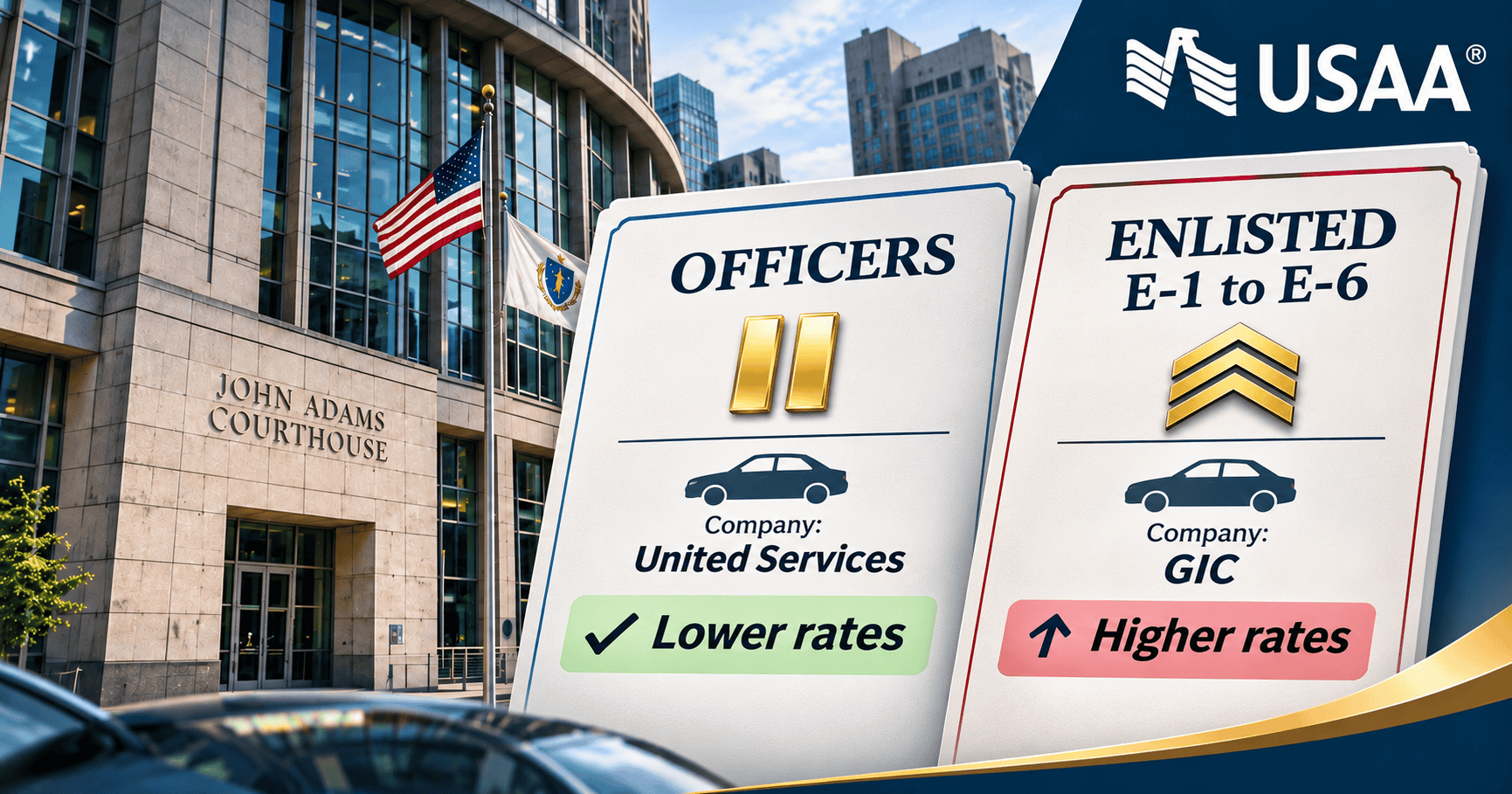
Under the eligibility structure described in the litigation, United Services generally insures military members whose highest career pay grade was E-7 or above, while GIC insures members whose highest pay grades were E-1 through E-6.
The four plaintiffs, whose highest military pay grades were E-3 or E-4, obtained coverage through GIC.
The two companies calculate their rates using aggregate data for their respective insured populations. Because the groups’ data differ, their calculated rates differ. GIC charges higher rates, according to the First Circuit opinion.
The plaintiffs allege that GIC’s higher base rates result in premiums exceeding what they would have paid if insured through United Services.
Their complaint cited differences in base rates from an October 2022 Massachusetts filing, including 61% for bodily injury liability, 84% for personal injury protection, 22% for property damage liability and 25% for collision coverage.
Those comparisons concern base rates rather than the actual premium differences experienced by individual policyholders.
Massachusetts Regulation of Insurance Company Placement
The plaintiffs contend that USAA’s affiliate-placement system violates 211 CMR 79.04(12), which prohibits insurers from using certain factors, including income and occupation, to determine placement within an insurance company group.
They argue that military pay grade serves as a substitute for those prohibited factors. They also allege that the companies falsely certified compliance with Massachusetts insurance laws and regulations.
The insurers dispute those allegations.
Massachusetts law requires insurers to submit proposed automobile insurance rates to the Division of Insurance for approval before using them. Chapter 175E prohibits rates that are excessive, inadequate, unfairly discriminatory or contrary to public policy.
The Commissioner approved the rates at issue.
The First Circuit noted that the plaintiffs do not allege that the companies submitted false actuarial or other underlying data to the Commissioner. The opinion also states that no administrative hearing or judicial review was sought concerning the particular rates in question.
USAA Argues Approved Rates Cannot Be Challenged
USAA moved to dismiss the lawsuit, arguing that the filed-rate doctrine bars claims challenging insurance rates approved by the Commissioner.
The insurers maintain that the plaintiffs’ requested relief would interfere with the Commissioner’s rate-setting authority, including by requiring changes to approved rates or awarding restitution based on different rates.
The plaintiffs respond that they are challenging the insurers’ affiliate-placement practices and regulatory certifications rather than the reasonableness of the approved rates themselves.
On May 15, 2024, U.S. District Judge Allison D. Burroughs denied USAA’s motion to dismiss. That ruling permitted the Chapter 93A claim to survive the pleading stage but did not establish that USAA violated Massachusetts law.
Following the district court’s certification of the filed-rate issue for interlocutory review, the First Circuit agreed to hear the appeal.
First Circuit Rules Massachusetts Law Controls
The First Circuit determined that Massachusetts law governs because the dispute concerns state-regulated insurance rates and raises no federal statutory or regulatory issue requiring application of federal common law.
However, the appeals court found that Massachusetts decisions involving regulated utility rates did not conclusively resolve whether private policyholders may bring Chapter 93A claims concerning approved automobile insurance rates.
The plaintiffs relied particularly on the SJC’s 1979 decision in Lowell Gas Co. v. Attorney General, which permitted an action involving allegedly deceptive conduct associated with utility rates.
The First Circuit distinguished that case because the action was brought by the Attorney General, whose statutory enforcement authority differs from that of private litigants.
The appeals court also examined earlier decisions limiting collateral challenges to regulated utility rates.
Concluding that it could not reliably predict how the SJC would apply Massachusetts law, the court certified the controlling state-law questions.
An Earlier 93A Auto Insurance Rate Case and a Legislative Response
Although not mentioned in the parties’ briefing or the First Circuit’s certification opinion, an earlier Massachusetts automobile insurance dispute produced a legislative change concerning the relationship between Chapter 93A lawsuits and administrative remedies.
In Gordon v. Hardware Mutual Casualty Co., 361 Mass. 582 (1972), the SJC upheld dismissal of a policyholder’s Chapter 93A action involving the discontinuation of a 15% automobile insurance premium discount.
The policyholder alleged that the insurer failed to notify him that it would no longer seek regulatory approval for the discount before renewing his coverage.
The SJC concluded that the plaintiff should first exhaust potentially adequate administrative remedies available through the Commissioner of Insurance.
In 1973, the Legislature amended Chapter 93A, Section 9. The amendment modified the legal requirement that private plaintiffs exhaust administrative remedies before filing suit.
Under Section 9(6), as amended, failure to exhaust administrative remedies no longer bars a 93A action. Instead, the court may suspend the 93A proceedings, if certain conditions are met, to allow an administrative agency to review the dispute. However, the suspension is limited to six months. If the administrative agency involved has not taken final action within that time period, the court “shall terminate the suspension and bring the matter forward for trial.”
Two Questions Certified to the SJC
The First Circuit certified two questions to the Massachusetts Supreme Judicial Court:
First: On the facts of this case, under Massachusetts law, are private parties authorized to bring suit under Chapter 93A for alleged violations of state law arising out of motor vehicle insurance rates approved by the Commissioner of the Division of Insurance?
Second: Does the answer to the first question differ as to the declaratory, injunctive, and restitutionary relief plaintiffs seek?
The distinction among the requested remedies is important. The plaintiffs seek declarations concerning the challenged practices, injunctions preventing those practices and requiring compliant rate filings, and restitution for alleged excess payments.
The SJC’s answers may determine whether the litigation can proceed and whether different forms of relief are available.
For Massachusetts insurers, the questions concern the relationship between regulatory approval of automobile insurance rates, insurer affiliate-placement practices and private enforcement of state insurance laws through Chapter 93A.
The First Circuit retained jurisdiction over the appeal pending resolution of the certified questions. It did not reverse the district court’s denial of USAA’s motion to dismiss or determine the merits of the policyholders’ claims.

Owen Gallagher
Insurance Coverage Legal Expert/Co-Founder & Publisher of Agency Checklists
Interested in connecting with me? Call me directly at 617-598-3801.