Union Benefit Funds Avoided the 65-Day Notice Requirement by Establishing Third-Party Beneficiary Rights
A Massachusetts Appeals Court decision issued last week may alter how sureties, contractors, and construction professionals evaluate payment bond exposure on public projects involving union labor.
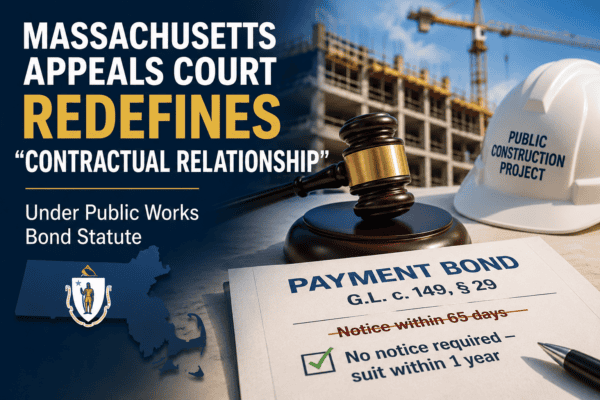
In New England Carpenters Central Collection Agency v. Arch Insurance Company, the Appeals Court concluded that union benefit funds were not required to comply with the 65-day notice provision of Massachusetts’ public works bond statute because they had a “contractual relationship” with the project’s general contractor—even though they were not parties to the construction contracts themselves.
The June 10 decision turns on a deceptively simple question: What does the term “contractual relationship” mean under Massachusetts General Laws Chapter 149, Section 29?
The court’s answer allowed the claimants to pursue payment bond claims that otherwise appeared vulnerable to dismissal under long-standing notice requirements.
The Dispute Began With Delinquent Fringe Benefit Contributions
The case arose from two public construction projects: the Randolph Intergenerational Community Center and the Dedham Town Hall.
CTA Construction Company served as general contractor on both projects and obtained payment bonds from Arch Insurance Company as required by G.L. c. 149, § 29.
Two subcontractors allegedly failed to make required fringe-benefit contributions owed under a collective bargaining agreement with the carpenters’ union. The New England Carpenters Central Collection Agency (NECCCA), acting on behalf of several employee benefit funds, sought recovery under Arch’s payment bonds.
NECCCA sent notices to CTA asserting claims against the bonds. The problem was timing. The notices were sent before the subcontractors had completed their work on the projects.
Massachusetts courts have historically enforced Section 29’s notice requirements strictly, and premature notices generally are ineffective. The Superior Court therefore granted summary judgment for Arch, concluding that the benefit funds failed to comply with the statute’s notice provisions.
Understanding Section 29’s Two Classes of Claimants
The Appeals Court’s decision hinged on how Section 29 treats different categories of claimants.
Under the statute, claimants with a contractual relationship to the general contractor occupy one category. Those claimants are not required to provide preliminary notice and may enforce their rights by filing suit within one year.
A second category includes claimants whose contractual relationship exists only with a subcontractor. Those claimants must provide written notice to the general contractor within 65 days after their last work or delivery of materials.
The distinction is critical because failure to satisfy the notice requirement can defeat an otherwise valid bond claim.
For decades, sureties have relied on those notice provisions as an effective defense against claims that fail to meet the statute’s procedural requirements.
The Court Focused on Third-Party Beneficiary Rights
The Appeals Court did not relax the notice requirements of Section 29.
Instead, it concluded that the notice requirements never applied to these claimants in the first place.
That conclusion stemmed from the court’s analysis of the collective bargaining agreement governing the projects.
The agreement required the general contractor, upon notice of a subcontractor’s delinquency, to assist in collecting unpaid contributions and, if requested, to issue two-party checks payable jointly to the subcontractor and NECCCA.
The court concluded that these provisions made the benefit funds intended third-party beneficiaries of the agreement.
That distinction proved decisive.
Under contract law, an incidental beneficiary may receive some benefit from a contract but possesses no enforceable rights under it. An intended third-party beneficiary, by contrast, is specifically intended to benefit from contractual promises and may enforce those promises.
The Appeals Court found that the collective bargaining agreement imposed specific obligations running from the general contractor directly to NECCCA and the benefit funds. Those obligations included assisting in collection efforts and issuing joint checks when requested.
Because the agreement granted enforceable rights to the funds, the court concluded they were intended—not incidental—beneficiaries.
Why “Contractual Relationship” Became the Key Issue
Having determined that the funds were intended third-party beneficiaries, the Appeals Court turned to the statutory language.
The court noted that Section 29 does not use terms such as “direct contract,” “privity,” or “party to the contract.” Instead, the Legislature chose the broader phrase “contractual relationship.”
That distinction became central to the outcome.
According to the court, intended third-party beneficiaries possess enforceable contractual rights even though they did not sign the agreement creating those rights.
As a result, the court held that the benefit funds had a contractual relationship with the general contractor for purposes of Section 29.
That interpretation moved the funds from the statute’s second category of claimants—those subject to the 65-day notice requirement—into the first category, where no preliminary notice was required.
Once the court reached that conclusion, the timing of NECCCA’s notices became largely irrelevant. Because the funds were not required to provide notice under Section 29, their claims survived despite the premature filings.
The Appeals Court vacated the summary judgment entered for Arch and returned the case to the Superior Court for further proceedings.
What the Decision Means for Sureties and Contractors
The decision does not eliminate Section 29’s notice requirements, nor does it automatically exempt union benefit funds from those requirements.
Rather, the ruling demonstrates that courts may look beyond traditional contract privity and examine whether contractual documents create enforceable rights sufficient to establish a statutory “contractual relationship.”
For sureties, the decision may narrow a defense historically available in payment bond litigation.
For contractors and their advisors, the case highlights the importance of reviewing collective bargaining agreements and other project documents for provisions that create direct obligations running to third parties.
Where those provisions exist, parties who never signed the contract may nevertheless be treated as having a contractual relationship under Section 29, potentially altering the notice requirements and deadlines that govern payment bond claims.
The Appeals Court’s decision suggests that, at least in some circumstances, the meaning of “contractual relationship” extends beyond the traditional boundaries of contract privity. In doing so, the court may have expanded the range of claimants able to pursue public works payment bond claims without satisfying the statute’s 65-day notice requirement.
View more Massachusetts insurance coverage cases here

Owen Gallagher
Insurance Coverage Legal Expert/Co-Founder & Publisher of Agency Checklists
Interested in connecting with me? Call me directly at 617-598-3801.