
Chubb Limited shed a significant volume of large account and excess and surplus property premium in the second quarter rather than write it at market pricing, and told analysts on July 22nd that the soft conditions driving that decision have now spread beyond property into casualty lines.
Chairman and Chief Executive Officer Evan G. Greenberg said market pricing for the shared and layered major accounts and specialty business Chubb declined or passed on during the quarter was down roughly 40%. Pricing on comparable business the company did write fell 12%.
The pullback shows up directly in the top line. North America Commercial net premiums written fell 2.3% to $5.59 billion, with major accounts retail and E&S wholesale down 9.0% to $3.26 billion because of property. Excluding large account and E&S property, that same major accounts and specialty book grew 0.4%, and North America Commercial as a whole grew 4.1%.
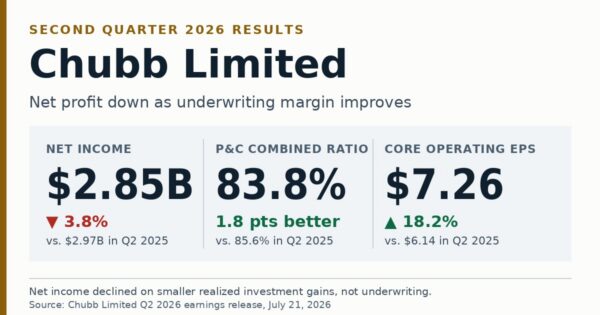
Chubb still posted core operating income of $2.84 billion, or $7.26 per-share, up 14.6% and 18.2% over the prior year, with a property and casualty combined ratio of 83.8%, improved from 85.6%. Net income was $2.85 billion, or $7.30 per share, down from $2.97 billion, a decline driven by smaller realized investment gains than the prior-year quarter rather than by underwriting.
Casualty pricing is not keeping pace with loss costs
Greenberg said U.S. casualty loss costs are rising at 6% to 7% annually for primary casualty and 9.5% to 12% for excess, varying by class. Asked whether loss cost inflation was moderating, he said there is “zero evidence across the industry that loss costs have abated,” adding that a steady rate of increase should not be mistaken for improvement.
Against that, North America commercial property and casualty pricing excluding financial lines and workers’ compensation rose just 1.3% in the quarter — and that increase came entirely from exposure. Rate was down 1.4%; exposure change was up 2.7%. Property pricing fell about 6%, with rate down 10.5% against exposure up 5.2%.
Casualty was the exception: North America casualty pricing rose 7.1%, with rate up 6.4% and exposure up 0.7%. Financial lines pricing rose 0.3%. In middle market and small commercial, property pricing rose 2.3%.
Greenberg described a pattern in which experienced carriers are holding discipline while newer entrants, MGAs, and smaller companies are writing financial lines at inadequate prices and terms — in some cases terms he said experienced underwriters discontinued 20 to 25 years ago. Separately, he noted London wholesale markets have been writing U.S. casualty for several quarters at rates and terms he said can only end one way.
Middle market and small commercial carried the growth
Middle market and small commercial net premiums written rose 8.9% to $2.34 billion, with P&C lines up 12% and financial lines down about 3%. Greenberg said the division writes more than $9.5 billion in gross premiums annually and attributed its position to the combination of agency and brokerage capabilities that came out of the ACE–Chubb merger roughly 11 years ago, along with industry-specific product design and branch reach.
North America Commercial’s combined ratio deteriorated to 85.4% from 83.5%, reflecting a 1.3 point increase from higher catastrophe losses and a 0.5 point increase in the current accident year loss ratio excluding catastrophes.
High-net-worth personal lines posted a 67.3% combined ratio
North America Personal net premiums written rose 6.0% to $2.05 billion, and the combined ratio improved 6.2 points to 67.3% — the strongest margin in any Chubb P&C segment. On a current accident year basis excluding catastrophes it was 69.9%, down from 72.2%. Account-level renewal retention held at 90%.
Greenberg said the improvement reflects rating algorithm complexity and risk selection rather than rate alone, and distinguished Chubb’s high-net-worth book from the general market auto and homeowners business where most personal lines pricing pressure is being discussed. The North America Personal book now exceeds $8 billion in gross premiums annually.
North America Agriculture rose 6.0% to $776 million with a combined ratio of 89.7%. Overseas General net premiums written rose 10.2% to $3.99 billion, or 4.8% in constant dollars, with consumer up 12.1% and commercial up 8.8%; Latin America grew 15.6%, Asia 12.0%, and Europe 5.1%. Its combined ratio improved 8.1 points to 82.2%, largely on lower catastrophe losses.
Run-off reserves developed adversely on molestation claims
Total pre-tax favorable prior period development was $283 million, against $249 million a year earlier. That figure nets two movements: $441 million favorable in the active companies, split 89% short-tail and 11% long-tail, offset by $158 million of adverse development in the corporate run-off portfolio, more than two-thirds of it from molestation-related claims.
Pre-tax catastrophe losses were $475 million, down from $630 million. Net loss reserves rose 4% to nearly $69 billion. The paid-to-incurred ratio was 90%, or 86% excluding catastrophes, prior period development, and agriculture — well below the roughly 97% Chubb averaged before the pandemic, which Greenberg said speaks to reserve strength.
Investments, capital, and ratings
Total invested assets reached $175.4 billion, up from $161 billion a year earlier. Adjusted net investment income was a record $1.88 billion, up 11.4% from $1.69 billion; pre-tax net investment income rose 12.3% to $1.76 billion. The fixed income book yield was 5.1% against a new money rate averaging 5.5% at June 30.
Chubb returned $1.37 billion to shareholders — $979 million in repurchases at an average $327.18 per share, plus $395 million in dividends — and a new $7.5 billion repurchase authorization took effect July 1 with no expiration date. Weighted average diluted shares fell to 391.3 million from 403.8 million, which accounts for most of the gap between 14.6% core operating income growth and 18.2% core operating EPS growth.
Tangible book value per share reached $131.93, up 17.1% from $112.64. As of June 15, 2026, Chubb’s principal U.S. operating entities, including Federal Insurance Company, Great Northern Insurance Company, and Vigilant Insurance Company, carried financial strength ratings of A++ from AM Best, Aa2 from Moody’s, and AA from S&P and Fitch, all with stable outlooks.
What it means for Massachusetts agents
Chubb does not report state-level results, so none of this is Massachusetts data. But the direction is usable. Property capacity is getting cheaper and easier to place, and a disciplined carrier is stepping back from it — which means the competition filling that space is pricing well below where Chubb will go. On the casualty side, the gap between 6% to 12% loss cost inflation and low single-digit rate movement is the number to carry into renewal conversations. And a personal lines book running at a 67.3% combined ratio with 90% retention is a carrier with room to compete for high-net-worth accounts.
In the press release, Greenberg said Chubb “will not underwrite knowingly at a loss,” and that the growth penalty it is paying in property will dissipate going forward.
Figures in this article are drawn from Chubb Limited’s second quarter 2026 press release dated July 21, 2026, the July 22, 2026 earnings call transcript, the Chubb Limited Financial Supplement dated June 30, 2026, and Chubb’s ratings summary as of June 15, 2026.
